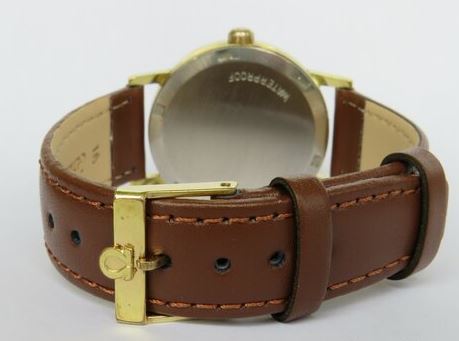
This may seem like a strange topic, “The history of vintage watch buckles” because, in the world of vintage watch collecting, it isn’t the component or feature of a watch that first comes to mind. However, in terms of overall originality and authenticity, it is the most likely part of vintage watch hardware to be missing. There is a simple reason for this. The majority of buckles are attached to leather straps, which naturally wear out and are replaced.
We know that with modern leather straps, we’ll be lucky to get 18 months of daily wear before a strap needs to be replaced. So, imagine how many times a vintage watch has had a leather strap replaced. Each time is an opportunity for the original to go missing. The owner probably didn’t even notice at the time, if ever, that the original buckle had been replaced by a sad, generic-looking buckle. If you are lucky enough to have an original buckle, guard it jealously because it has real value. Original buckles, of which we own few, are the inspiration for this post.
Wartime necessities and practical origins
In the late 1800s, watches were becoming more widely used. Military operations required quick and easy access to time. During conflicts such as the Boer Wars in South Africa and the Third Burma War of 1885, soldiers needed a secure method to fasten their timepieces. Early leather straps with buckles were introduced to meet this need. These first designs were simple and practical. They allowed military personnel to keep their watches safely on their wrists during stressful operations. The use of leather also provided durability and a comfortable fit. Early adopters discovered that the secure strap and buckle combination could make a significant difference in timing critical events. These straps, initially simple and rudimentary, evolved over time, particularly during WW1 when trench watches became prominent.
Keeping the watch secure
The buckle serves a simple purpose. It secures the watch on the wearer’s wrist, where it is easily accessible. Without a good buckle, a watch might slip or even fall off. This could lead to the watch suffering damage or even becoming lost. A well-designed buckle makes it easy to adjust the strap to the perfect length. In everyday life, this means the watch stays comfortably in place. Whether you are at work or enjoying a day out, a reliable buckle is essential. It ensures that the watch remains a constant companion without causing any inconvenience.
Different buckle types
There are several types of buckles found on vintage watches, each with its own characteristics. The most common types include the pin buckle, the deployant clasp, and the butterfly clasp.
The classic pin buckle
One of the earliest and most enduring designs is the pin buckle. This style first appeared in the late 19th century. The pin buckle is sometimes known by other names. It may also be called the “tang” or “ardillon” buckle (“ardillon” is a French word that translates to “tongue”). In use, the buckle rests on the shorter end of the strap. A metal pin, often referred to as the buckle tongue, sits in the centre. The longer strap, with several adjustment holes, passes through the buckle. The pin is inserted into one of these holes to secure the watch on the wrist. This simple yet effective design helped establish the pin buckle as a standard choice for many. Its straightforward mechanism made it easy to use for people of all ages.

The deployant clasp
Another design that gained popularity is the deployant clasp (French: bouclé déployante, English: folding clasp). This buckle combines elements of the pin buckle into a folding mechanism. It has one or two folding sections that allow it to adjust smoothly to the wrist. The clasp includes a metal pin buckle on one end and a spring bar on the other. The spring bar is attached to the shorter end of the strap, while the metal pin buckle connects to the longer side with adjustment holes. Once the wearer selects the right fit, the buckle clicks securely into place. The deployant clasp is usually made from stainless steel and was patented by Cartier in 1909.
Note, there is some dispute online about the correct terminology, whether it is deployant, deployment or déployante? We have given up on finding the answer and simply use deployant.
The butterfly clasp
The butterfly clasp is another noteworthy design in the evolution of watch buckles. Sometimes called the double deployant clasp, it uses two short metal hinges. These hinges open like wings and snap together over a central piece. A small, discreet button on the side controls the opening and closing. One attractive feature of this buckle is its ability to hide most of the internal mechanisms. This creates a smooth, uninterrupted appearance on the surface of the strap. However, the design can sometimes feel bulky on smaller wrists. Despite this, many appreciate its unique visual appeal and secure fastening.
Buckle design
Typically, vintage watch buckles are made from stainless steel. A watch buckle’s design can be minimalistic or highly decorative, depending on the watch’s style. Many luxury brands integrate their logo or signature elements into the buckle, making it a recognisable feature. Some buckles include engraved or embossed logos for subtle branding. High-end watches may even feature buckles adorned with precious stones or detailed engravings, showcasing the precision and craftsmanship behind each timepiece.

Conclusion
Though small, the buckle is vital to a vintage watch’s function, security and appearance. It ensures a secure fit while complementing the watch’s overall design. Understanding buckle details can deepen your appreciation for vintage watches and guide your choices when selecting one. The buckle is the most likely component of a vintage watch to be missing. However, replacement vintage buckles are available online, at a premium. There are also “aftermarket” buckles with branding available. Exactly what vintage they are is hard to tell. However, given that the basic design of buckles has hardly changed in a century, a modern replacement is not going to look out of place. And, if you have the patience, that replacement buckle will, one day, become vintage in its own right.
Leave a Reply