In 1894, Numa Emile Descombes and Ulysse Georges Perret founded a workshop in the Swiss town of Le Locle. They chose the name Universal Watch for its global appeal, and according to Mikrolisk, registered the trade mark in January 1894. Descombes had an Italian wife, who helped them build an early sales network in Italy. They registered brands like La Meridiana specifically for the Italian market. Tragedy struck the young firm in 1897 when Descombes died suddenly. Perret then found a new partner in Louis Berthoud, and the company name became Perret and Berthoud for several decades. The firm moved its main office to Geneva in 1919, and they settled at the prestigious Rue du Rhone in 1921. Interestingly, this address sat between the workshops of Rolex and Patek Philippe. It demonstrated that Perret and Berthoud wanted to compete at the very top of the market (The history of Universal Genève at Grail Watch Wiki).
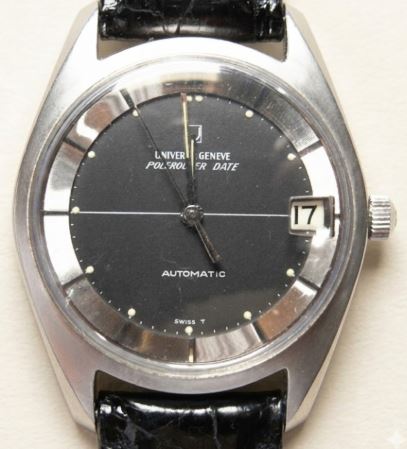
Universal Genève began to make significant progress in the 1930s with stopwatch designs. Raoul Perret, the son of the founder, Ulysse-Georges, joined the firm in 1923 and became director in 1932. During that period, the Swiss watch industry faced a financial crisis when American modern industrial techniques began undermining the Swiss system. Many Swiss watchmaking companies joined the large ASUAG trust to survive. However, Perret and Berthoud decided to remain an independent manufacturer, which allowed them to keep making their own movements.
Chronographs
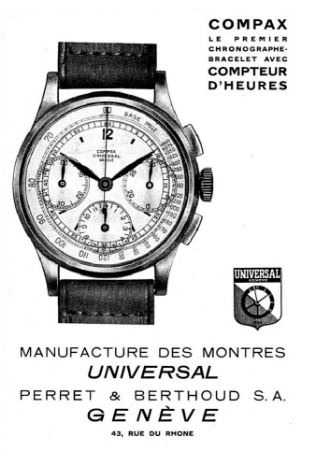
The firm began to focus heavily on chronographs in 1934, which would become its most famous area of expertise. Perret & Berthoud SA registered the Compur name in Geneva, Switzerland, in 1934. In the same year, a chronograph, the Compur, was introduced, featuring two pushers to start and stop the timer and a double-column-wheel system. Shortly after, in 1936, they launched the Compax, which was the first wrist chronograph to feature an hour counter. Apparently, it was designed, at the request of Hermes in Paris, for their elite clientele. The company officially took the name Universal Genève in 1937 (The true story of Universal Genève at Time2Tell).

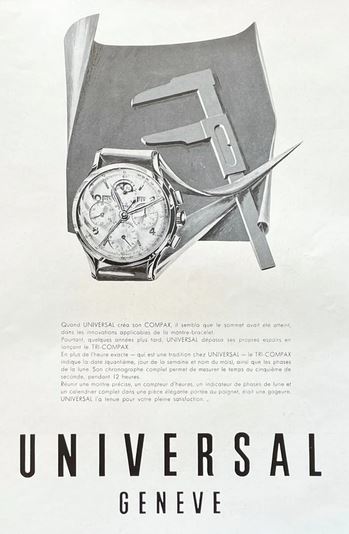
Universal Genève reached its fiftieth anniversary in 1944. To celebrate, they unveiled the Tri-Compax, which added a full calendar and moon phase to the already impressive chronograph. Famously, this watch found its way onto the wrist of US President Harry Truman during the Potsdam conference in 1945.
Polerouter
The chronographs built their reputation. However, the 1950s Polerouter (initially Polarouter) made Universal Genève a household name. Scandinavian Airlines System wanted a watch for their crews who were flying a new transpolar route from Copenhagen to Los Angeles. Magnetism near the North Pole was a nightmare for navigation instruments and standard watches. To counter these effects, Universal developed an anti-magnetic watch to handle the flight. They hired a freelance designer named Gerald Genta to draw up the design. He was only twenty-three at the time and had no idea he was starting a career that would change the entire industry. The design featured twisted lugs and a textured inner ring, which helped hold the crystal in place against pressure. It also protected the movement from dust and moisture. The twisted lugs and textured inner ring are features that collectors still obsess over today (Polerouter at Universal Genève).
The micro-rotor
Universal Genève also contributed to automatic winding technology when it patented the micro-rotor in 1955. By integrating the winding weight into the movement itself rather than perching it on top, they could make automatic watches much thinner. This led to the Shadow collection in 1966, where the Golden Shadow and White Shadow models used the calibre 66. This movement was only two and a half millimetres thick, which was a world record for over a decade.
The 1960s brought a shift toward sportier Universal Genève designs that really captured the fashion of the time. Nina Rindt, the stylish wife of the racing champion Jochen Rindt, often wore a white-dial Compax with black registers on a wide leather strap. This panda dial look became so famous that collectors now refer to that specific reference as the Nina Rindt. At the same time, the legendary guitar player Eric Clapton was seen wearing a steel Tri-Compax while he was with the band Cream, which gave that reference its own lasting nickname.
Compax variants
The Space-Compax arrived in 1967 with rubber-capped pushers and an asymmetrical case that looked like nothing else on the market. People still argue about whether they designed it to win a NASA contract or if it was just a very robust diving watch. The Medico-Compax was far more practical and helped doctors measure heart rates using a pulsometer scale on the dial. These specialised tool watches showed that Universal Genève could cover all aspects of the market.
Quartz Crisis
The Quartz Crisis in the 1970s hit the Swiss industry very hard, and Universal Genève was no exception. They tried to adapt and even released the world’s thinnest analogue quartz movement in 1975. However, they eventually lost their footing in the market. The Stelux group from Hong Kong bought the brand in 1989, and while they kept the name alive, the innovation mostly stopped. For a long time, the brand was a sleeping giant that only vintage lovers really talked about.
A new beginning
Everything changed in December 2023 when Breitling announced it had purchased the brand. They plan to position it as a premium name that sits above Breitling in terms of luxury timekeeping. The full relaunch will happen in September 2026, and the plans are quite ambitious. The range is expected to include some tribute models, but will also include modern watches. Time will tell.
Summary
Universal Genève was a well-regarded and historic Swiss brand that had been effectively dormant since the Quartz Crisis of the 1970s. The brand survived over the following decades due to the takeover by the Stelux holding company. Vintage watch collectors admire the brand thanks to its fine record of producing classic watches such as the Compax, Polerouter and the Tri-Compax. Additionally, Universal Genève were the first to successfully produce chronograph wristwatches and perfected the Micro-rotor movement, which allowed for incredibly thin automatic watches. However, the brand was hardly at the forefront of modern watchmaking until Breitling took ownership in 2023. At Set Back in Time, we admire the brand thanks to its work during its heyday between the 1930s and the 1960s. It’s worth considering vintage Universal Genève pieces from this period. However, be careful of redials. Since the takeover by Breitling, there has been renewed interest in the brand, and unscrupulous sellers might try to pass off redials as original.
Related content
Under the Radar: Universal Genève at Analog:Shift.
Leave a Reply