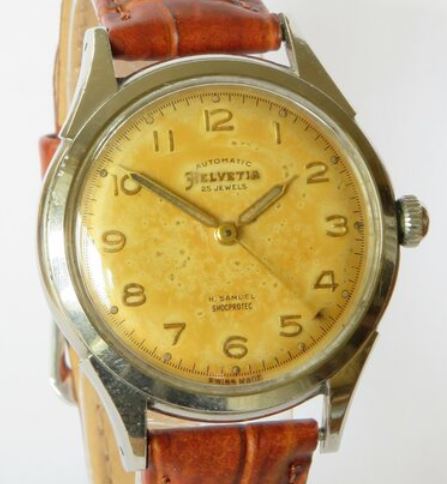
This watch was brought to the attention of the Set Back in Time group a few weeks ago. No one in the group was particularly interested in buying, but it did have a few characteristics that caught our attention and made for a lively discussion. First was the “tropical dial”, which tends to be a “love or hate” feature amongst collectors (our group was split). Second, the retailer, H. Samuel, is a common sight on UK high streets. And lastly, the use of the term SHOCPROTEC on the dial. We have done some research over the past few weeks, and here is what we have discovered about this Helvetia automatic with a tropical dial.
A brief history of Helvetia
Louis Brandt & Frère, the founding family behind Omega, registered the Helvetia watch brand in 1892. Then in 1895, Brandt and Edouard Boillat formed the manufacturing entity Société d’Horlogerie La Générale, which focused its production on the Helvetia name. In the early 20th century, the firm expanded in Biel/Bienne and rapidly adopted the wristwatch format. Its reputation grew through the 1920s and 30s as it patented key technical advances, including innovative shock protection and water-resistant cases (Helvetia at Chronopedia).
Helvetia is best known for its 1930s–1940s pilot watches, which often featured striking dials and a notable propeller logo. The company continued to be a producer of military, dress, and automatic models, introducing its first automatic movement in 1950. Despite its long history, the original Helvetia company was absorbed in the industry turmoil of the 1970s. However, vintage pieces, especially their pilot watches, are sought-after on the collector’s market today.
The history of H. Samuel
H. Samuel is a familiar name on high streets across the United Kingdom and Ireland. It is currently operating over 300 retail stores and boasts 160 years of history. What makes this story particularly interesting is its founder: Harriet Wolfe Samuel (1836–1908). Harriet established the company during an era when women were severely limited, often being denied the right to vote or receive a formal education. This was notable in customer correspondence where letters were routinely addressed to ‘Dear Sir’ or ‘Mr H. Samuel’.
Born in London in 1836, Harriet married Walter Samuel, who ran his father’s watchmaking business in Liverpool. When Walter passed away in 1863, Harriet took over the business and relocated to Manchester. She successfully managed the innovative mail-order service while her son, Edgar, focused on the retail operations. The family opened the very first H. Samuel retail store in Preston in 1890, ultimately developing the firm into one of Britain’s leading high-street jewellery chains. Like many retailers of the time, H. Samuel would purchase finished watches and sell them with their name branded on the dial (Harriet Samuel at Wikipedia).
Helvetia 837 automatic
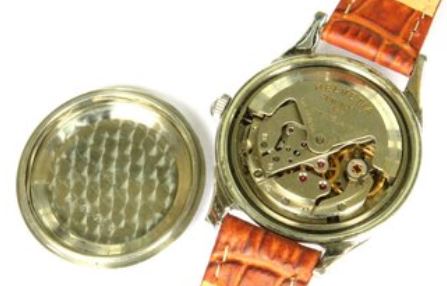
According to the Ranfft DB, the Helvetia 837 automatic was in production from 1950. It features 21 or 25 jewels, a power reserve of 43 hours and a frequency of 18,000 vph. Interestingly, the new range included Incabloc shock protection, which replaced “Shock-Resist”, which was Helvetia’s in-house system. Another interesting “feature”, common with many Helvetia watches, the anti-clockwise winding to power the automatic movement. Period advertising by Helvetia promoted the 837 movement as: “The watch you never wind… THE HELVETIA AUTOMATIC”.
Case and dial
The watch measures 34mm in diameter, excluding the winding crown and the lugs. The case is stainless steel, and it is in very good condition. The screw-on case back states that the watch is waterproof. However, as with any vintage watch, it should be kept away from water and moisture. The acrylic crystal is in good condition. The dial features the original hands, centre seconds hand and outer minute markers. The watch includes a new brown leather strap. The signed dial is its original finish, which has aged beautifully over the years, giving an even tropical patina.
The term tropical dial describes a vintage watch whose dial has undergone a significant, non-factory colour alteration. This transformation is a direct result of the chemical interaction between the dial’s material and environmental factors, such as UV light and moisture. Because these conditions are most common in tropical areas, the resulting colour change is referred to as a tropical dial. Some vintage watch collectors value tropical dials because no two are exactly alike. The natural ageing process ensures that each watch featuring this unique discolouration is a one-of-a-kind timepiece.
In-house shock protection
Helvetia developed and patented its in-house shock protection system in the late 1920s (Patent CH143073, 1930) to safeguard the delicate balance staff from physical impacts. The core mechanism involved a flat, three-legged spring held by a boss over the cap jewel, designed to absorb and cushion external shocks. A notable feature was a small notch in the boss, which allowed for simple removal and replacement of the spring, simplifying maintenance for watchmakers (Helvetia Shock Protection at Helvetia).
Though later rebranded as “Helvetia Shock-Resist” in the 1940s, the system remained a distinctive, proprietary feature of Helvetia watches. Despite its effectiveness, it never achieved the industry-standard status of rival systems like Incabloc and KIF. Consequently, Helvetia abandoned its own design and transitioned to using the universally adopted Incabloc system in the early 1950s.
SHOCPROTEC
So what is SHOCPROTECT? Initially, we thought it might be associated with H. Samuel, but this doesn’t seem to be the case. There are a few other examples online of Helvetia watches with SHOCPROTEC on the dial, but without the H. Samuel branding. Perhaps Shocprotec was an in-house system that was never formally trademarked or patented? Maybe a temporary name for the Incabloc system? Despite extensive online research, we have been unable to determine the source or any specific details behind the SHOCPROTEC name.
Summary
This Helvetia 837 automatic would certainly appeal to those collectors who appreciate tropical dials. Helvetia are certainly a respectable brand, and all of the material online suggests that the 837 calibre is a reliable movement. The reference to SHOCPROTEC is the missing piece of the puzzle. Any further information would be gratefully accepted in the comments below. This watch certainly generated a lot of discussion amongst the group. However, nobody reached for their wallet. At the time of writing, the watch remained unsold.
Leave a Reply