This is a recent addition to the Set Back in Time collection, a Tissot Visodate Seastar Seven wristwatch dating from the 1960s. The watch has a hand-winding movement, which is working well. It is a Tissot calibre 782-1 with 17 jewels and a date function. The watch is a reliable and accurate timekeeper.

Tissot
Tissot is a Swiss watch brand with a long history dating back to 1853. It was founded by Charles-Félicien Tissot and his son, Charles-Émile Tissot, in the small Swiss town of Le Locle. Initially, Tissot built its reputation by building highly reliable, gold-cased pocket watches that found a strong and appreciative audience all over the world, particularly in the Russian market. Tissot quickly gained recognition for innovations in the watchmaking industry. They were among the first to introduce mass-produced pocket watches, making timepieces more accessible to the general public. Additionally, Tissot pioneered the production of watches with two time zones, which were particularly useful for railway workers and travellers (Tissot at Watch Wiki).
In 1930, Tissot merged with another renowned Swiss watchmaker, Omega, to form the SSIH group (Société Suisse pour l’Industrie Horlogère at Wikipedia). This collaboration allowed both brands to combine their resources and expertise, further solidifying Tissot’s position in the watchmaking industry. Throughout the years, Tissot continued to innovate, introducing groundbreaking technologies and designs. In the 1970s, they launched the Tissot RockWatch, featuring a case made from granite and other unconventional materials, showcasing the brand’s commitment to innovation and creativity.
Tissot expanded its presence globally and became known for its sports watches and chronographs. In 1983, the SSIH group merged with ASUAG to form the Swatch Group, which currently owns Tissot along with other prestigious watch brands. In recent years, Tissot has maintained its reputation for quality and innovation. The brand offers a wide range of watches, from classic dress watches to high-performance sports models. Tissot has also embraced smartwatch technology, integrating it into some of their timepieces while preserving their traditional Swiss craftsmanship.
Dial
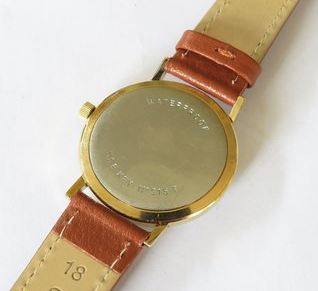
The watch measures 34mm in diameter, excluding the winding crown and the lugs. The case is stainless steel, and it is in good condition, with just light surface marking on the back of the watch. The case back bears a ‘waterproof’ stamp. However, as with any vintage timepiece, you should keep it away from water and moisture. The watch has the original Tissot winding crown.
This movement features an early quickset date display. To reach the desired date, move the hands repeatedly backwards and forwards between 12 midnight and 8:30 pm. In reality, it isn’t perfect. However, it does mean you don’t have to scroll through 24 hours over and over again to get the date right.
The dial is signed, “Tissot Visodate, Seastar Seven, T Swiss Made T”. The lens is a domed acrylic crystal in excellent condition, there are no obvious markings visible to the naked eye. The watch features a new brown leather Tissot strap with a Tissot gold-plated buckle.
Tissot Seastar Seven
Seastar is Tissot’s range of water-resistant watches. Tissot introduced the Seastar Seven watch in 1964. The “Seven” supposedly refers to seven “essential qualities” that Tissot felt set the watch apart from others in the same price range. We did stumble across a 1960 Tissot advertisement for Tissot Seastar Seven watches. The ad was in French, which we managed to decipher thanks to Google Translate (unedited).
Tissot Seven advertisement 1960
In a 1960s French advertisement for the Tissot Seven, there were a number of (7 obviously) features that were expected to appeal to the watch-buying public.
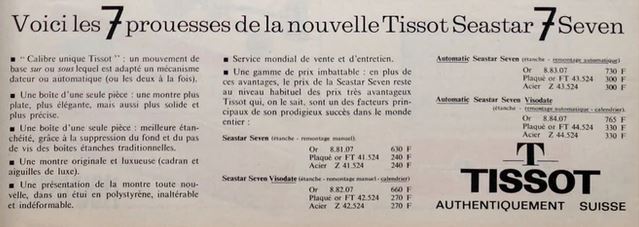
Here are the 7 tests of the new Tissot Seastar 7 Seven (translated):
- Unique Tissot calibre: a base or sub-base movement that is adapted to a date or automatic mechanism (or both at once).
- A single-piece case: a more elegant, more solid, and more precise watch.
- A single-piece case that is more waterproof, thanks to the bottom and non-slip properties of traditional waterproof cases.
- An original and luxurious watch (deluxe case and hands).
- A presentation of the brand new watch, in a polystyrene case, unalterable and non-deformable.
- Worldwide sales and entertainment service.
- An unbeatable price range in addition to these advantages, the Seastar Seven price remains at the usual level of Tissot’s top prices, which, as we know, are one of the main factors of their prodigious successes worldwide.
Tissot Seven advertisement, 1964
We found another advertisement from around the same time, again in French, (Google Translate – unedited):
“One-piece watch case: a thinner, more elegant, but at the same time more solid and precise watch. One-piece watch case: increased water resistance, because the Seastar Seven no longer needs a screwed back. One-piece watch case: prevent any corrosion. A shapely watch in a luxurious guide (de-luxe dial and hands). All-new presentation of the Seastar Seven in a case made of unalterable and dimensionally stable polystyrene. Extremely favorable price range: in addition to all these advantages, the price of the Seastar Seven remains well within the range of the well-known advantageous Tissot prices. Worldwide sales and service“.
In summary, nice case, dial and movement, waterproof and affordable. Probably 5 essential qualities, but this probably doesn’t sound as good as 7. A piece of flexible marketing, perhaps?
“T Swiss Made T”
The “Swiss Made” marking indicates that the watch was made in Switzerland under strict terms and conditions. It is a label or brand that represents quality in the global watchmaking industry. It is also a geographical trademark with protection under a number of Swiss and international laws and treaties. The “T” on either side of the marking indicates that the luminescence on the dial is triggered by tritium, a radioactive element, reacting with the paint on the hour markers and hands. Originally, this would have allowed users to read the time in the dark. Tritium was used for luminescence from the 1960s until the 1990s. Although not as dangerous as radium, it still exposed users to a radioactive health risk. Today, watch manufacturers typically use non-radioactive luminescent materials such as Super-LumiNova or LumiBrite. These offer similar visibility in the dark without the health risks associated with radioactive substances like tritium.
Tritium has a half-life of about 12.5 years, which means that its radioactivity diminishes by half every 12.5 years. The luminosity of tritium-based luminescent materials typically lasts for around 10 to 20 years before the brightness noticeably diminishes. In reality, any vintage “T Swiss Made T” watches are highly unlikely to show any practical luminescence. Vintage watch collectors, who value originality, generally prefer that restorers leave the luminescence untouched (Luminous Dials at Hodinkee).
Tissot 782-1 calibre
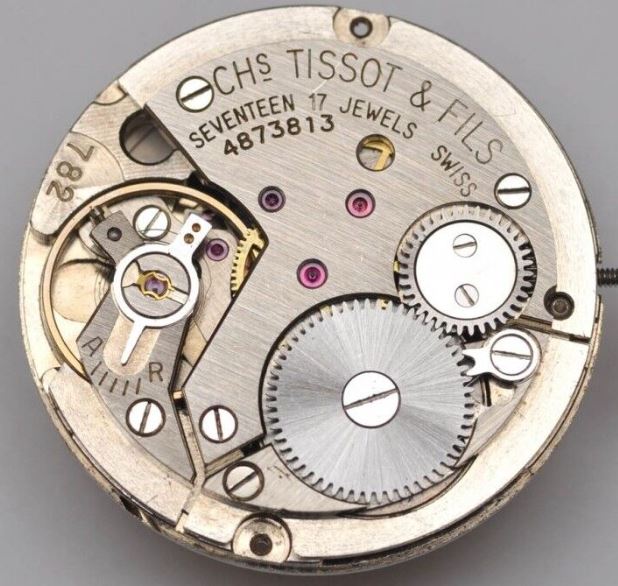
The Tissot 782-1 belongs to the calibre series 781-784, introduced by Tissot in the 1960s. Tissot designed these movements for cost efficiency, leaving out elaborate decorations and technical complexities. Despite their economical construction, the 782-1 maintains good quality and reliability.
The Tissot 782-1 calibre is a compact, reliable movement with a diameter of 11.5 lignes (approximately 25.4mm) and a relatively slim profile of 3.70mm. According to the Ranfft database, this 17-jewel movement utilises a monometallic annular balance with two legs and a traditional pallet lever escapement. It also features Incabloc shock protection. In terms of functionality, the calibre features a direct centre seconds hand and a date complication with quick-set functionality.
In summary, Tissot designed the reliable 782-1 movement for practicality, ensuring it suited timepieces that prioritise functionality over intricate complications. The service history of this watch is unknown.
Incabloc
The Incabloc shock protection system is the trade name for a spring-loaded system for the jewel bearings which support the balance wheel in a mechanical watch. This is designed to protect the pivots and bearings from damage if the watch is subject to a physical shock, for example, if the watch is dropped. Swiss engineers Georges Braunschweig and Fritz Marti developed the Incabloc system in 1934 at Universal Escapements, Ltd, in La Chaux-de-Fonds, Switzerland (Incabloc at Caliber Corner).
The components supporting the watch balance wheel are fragile relative to the weight they carry. Without shock protection, a sudden impact will likely break these parts before any others. Before the widespread use of shock protection systems such as Incabloc, broken balance staffs were a common type of damage needing watch repair.
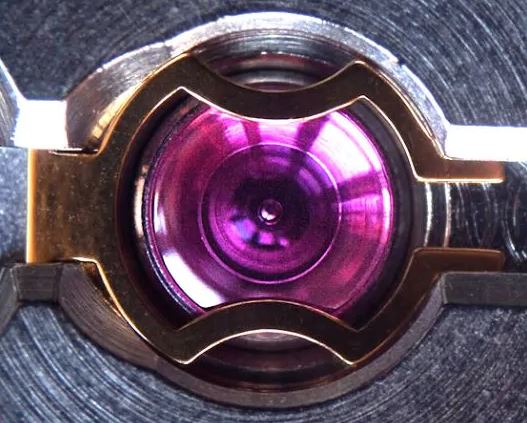
The Incabloc system uses a “lyre-shaped” spring to allow the delicate bearings to shift within their settings during impact until the stronger shoulder of the staff contacts the metal endpiece. This means that the pivots and bearings don’t have to bear the full force of the impact. When the impact is over, the springs guide the components back to their original positions. The staff itself does not move relative to the jewel bearing, but the whole bearing is carried in a metal bushing that is free to move in the metal endpiece, under the control of the spring.
Case
The monocoque case consists of a single shell without a removable case back, which improves water resistance. Extraction of the movement occurs from the front of the case. The bezel and the glass need to be removed first. However, front-loading complicates stem removal because there is no rear access to detach the stem. Additionally, you cannot remove the movement with its stem attached. Many monocoque cases use a split‑stem design. Pulling the crown releases the outer stem section and frees the movement. This watch uses a solid stem. Pulling the crown in error could damage vital movement components. To resolve this, remove the dial and hands. Then, dismantle the keyless works to free the stem. Finally, extract the movement safely.
Summary
The Tissot Visodate Seastar Seven is a nice-looking vintage watch which has aged well and keeps good time. It is accurate to within 30 seconds per day (fast) and has a good power reserve of approximately 49 hours when fully wound. It is a very welcome addition to any collection.
Related content
Collecting Swiss vintage watches: 10 mid-range brands worth exploring.
Leave a Reply