A watch complication, by definition, is any function of a timepiece that is in addition to its primary function of keeping time. One of the most common complications on modern watches is the Date function, which is a display of the date via a numbered disk. Typically, this is displayed via a small aperture or window at the 3 o’clock position. In this post, we will explore the history behind vintage watch date complications.

Date complications
In addition to the date function, some watches feature a Day-Date complication. This displays not only the date, but also the day of the week. Like the date complication, the day and date are shown through small windows on the watch’s dial. These windows can be positioned in various locations, such as at 12 o’clock or 3 o’clock.
A Triple Calendar complication enhances the day-date function by also including the month of the year. This means the day, date, and month are all visible through separate windows on the dial. However, a triple calendar requires manual adjustment at the end of months with varying lengths.
An Annual Calendar complication similarly displays the day, date, and month, just like a triple calendar. The key difference is that an annual calendar automatically adjusts the date to account for months with 30 or 31 days. The only manual adjustment required is at the end of February.
For ultimate convenience, a Perpetual Calendar complication goes a step further. It not only accounts for the varying lengths of months but also adjusts for leap years. A watch with a perpetual calendar is an excellent choice for those seeking a low-maintenance timepiece, as it won’t require calendar adjustments until the year 2100 (Date complications at Worn & Wound).
A. Hammerly?
Supposedly, Swiss watchmaker A. Hammerly filed the first patents for a date complication in 1915. We say “supposedly” because, despite the name and patents being reported on dozens of websites, we cannot find a source which lists the patent numbers. The name Hammerly isn’t listed in Mikrolisk, the horological trade mark index. Apparently, Hammerly submitted two date designs. The first was a pointer display, with a hand pointing to a specific date on the outer dial. The second took the form of the date being displayed through a window on the dial. In both instances, the date needed to be manually adjusted on a daily basis (Calendar watches at The Watch Collectors Club).
Mimo
The first wristwatch to incorporate a self-setting date window was created by Mimo (Manufacture Internationale de Montres en Or). This wristwatch was the Mimo-Meter, first released in 1930, and it incorporated a small date window at the 3 o’clock position. Interestingly, the owner of Mimo, Otto Graef, purchased the failing Girard-Perregaux brand in the 1930s. Otto Graef was a watchmaker of German origins who lived and worked in La Chaux-de-Fonds, Switzerland. In the 1950s, the third generation of the Graef’s family took over management. They managed to revive the Girard-Perregaux brand to such an extent that soon after, the Mimo name disappeared (Complication: Date at Fratello).
Oris Pointer Date
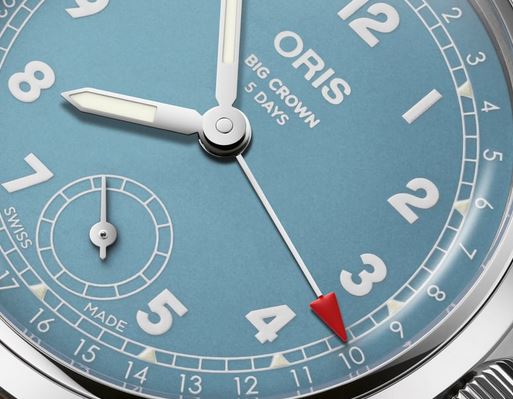
In 1938, Oris introduced a pilot’s watch with a pointer date function. This type of date display uses a centre-mounted hand that moves around the dial in daily increments to point to the current date on a numerical scale (1-31), usually marked on the outer dial. The Big Crown Pointer Date has been in continuous production since 1938 and is Oris’s longest-serving design. The “Big Crown” was a feature of pilot’s watches that allowed the watch to be wound and set when wearing pilots’ gloves.
Rolex
In 1945, Rolex introduced the Rolex Datejust, marketing it as the first wristwatch with a self-changing date. In the years that followed, Rolex introduced its ‘Cyclops’ date magnifier. This feature enhanced the date aperture, making it easier to read. Patented in the early 1950s and introduced on the Datejust in 1953, the Cyclops magnifier remains a Rolex signature feature. Further improvements came in 1955, with the date change occurring instantaneously at midnight as opposed to the slow changeover that occurred in the original Datejust model. In 1956, Rolex released the Day-Date, which is often referred to as the “President” watch. It was the first wristwatch to display both the full day of the week and the date on the dial (Rolex at Grail Watch Wiki).

Tissot
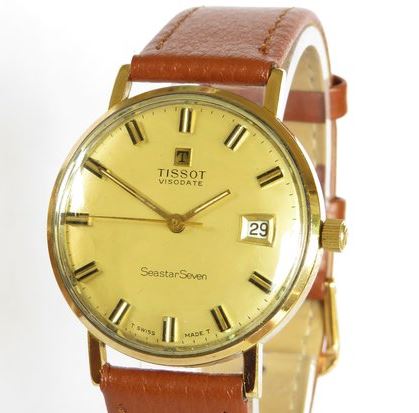
First launched in 1953 to celebrate Tissot’s centenary, the Visodate was one of the earliest watches to incorporate a date display into its automatic movement. The Visodate was the first automatic watch to feature a date window that instantaneously changed at midnight. According to Mikrolisk, Tissot registered the Visodate trademark in 1954.
How does it work?
Two rotating discs, located beneath the watch face, display the days of the week and the dates of the month. The day/dates automatically advance at midnight. However, manual adjustments are possible by turning the crown in one direction to change the day and in the opposite direction to change the date. Alternatively, some watches feature a small recessed button on the side, which users can operate with a stylus to make adjustments. However, most watches require manual correction at the end of months with fewer than 31 days, such as February or 30-day months, to ensure that the date remains accurate (Self-changing date at Watchfinder).
Quick set and the Danger zone
In early watch movements with a date function the hands had to be rotated for a full 24 hours to move the date forward a day. This proved to be inconvenient when needing to advance forward multiple day. The quick-set movement was designed to make this easier. In a full-quick-set movement, you can change the date independently of the time. Pulling the crown to its middle position allows you to cycle through the dates rapidly without spinning the hands. Conversely, a semi-quick-set movement lacks this dedicated setting. To change the date quickly, you must move the hands back and forth between roughly 9:00 PM and midnight. This repetitive “shuttling” trips the date-advancing mechanism without requiring a full 24-hour rotation (Quickset date feature at Watch Wiki)..
The danger zone refers to the period (typically 9:00 PM to 3:00 AM) when the movement’s internal gears engage to flip the date disc. During these hours, a delicate “finger” or lever physically locks into the date wheel. If you use the quick-set function during this window, you risk forcing the gears against this mechanical resistance. This error can shear teeth off the wheels or snap the advancing lever, resulting in an expensive repair. Consequently, you should always move the hands to the bottom half of the dial before adjusting the date.
Summary
A date window provides immediate daily utility. Mechanically, these timepieces demonstrate superior watchmaking complexity, as the additional gears and discs highlight the technical skill of the era. Consequently, rare and more complicated date layouts often enjoy higher desirability and stronger resale value among collectors. However, the extra components increase maintenance costs and the risk of mechanical failure. Many vintage movements also lack a “quick-set” function, forcing you to rotate the hands repeatedly to reach the correct date, which accelerates wear. Most of the watches in the Set Back in Time collection are without the date function. In reality, this is simply due to the added cost of servicing the complication.
Related content
Complications (Horology) at Wikipedia.
A Brief History of Date Windows at Goldammer.
Leave a Reply