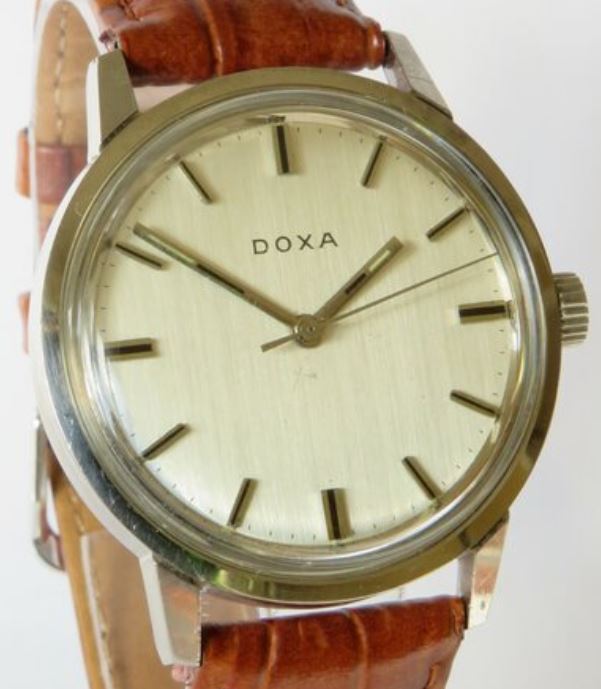
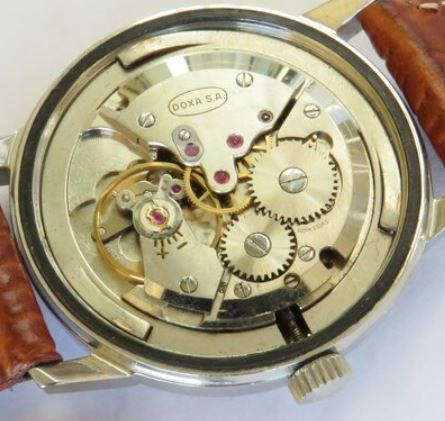
This watch was introduced to the Set Back in Time group by a regular to our weekly meetings. It’s not a top-of-the-range brand, just a really nice-looking vintage gentleman’s wristwatch. Doxa is a relatively little-known brand that has a long history and a reputation built on modern dive watches. The watch has a signed 17-jewel hand-winding movement, a Doxa 103, which is working well and keeping good time. We did some research and here is what we uncovered.
A brief history of Doxa
Georges Ducommun (1968 – 1936), the founder of the Doxa watch company, was born in Le Locle, Switzerland. Ducommun began his apprenticeship in 1880 and, by 1889, at just 21 years old, started his own business as an independent watchmaker. He quickly built a solid reputation for excellent customer service and attention to detail, eventually creating the Doxa brand, a name which means ‘glory’ in Greek. According to Mikrolisk, Ducommun registered the Doxa trademark in 1902. Ducommun’s craftsmanship gained swift international recognition. The antimagnetic watches which he developed in the early 1900s became the hallmark of his company (Doxa history at Grail Watch Wiki).
Ducommun’s creativity was evident during the early 20th-century automobile revolution when motor racing required reliable timing instruments. He developed a robust and reliable dashboard-mounted timepiece with a long-life power reserve. In 1908, he patented the “8-Day Doxa Caliber,” which subsequently became standard equipment on Bugatti racing cars. Following Georges’ death in 1936, his son-in-law took over the company. Unlike many of its contemporaries, Doxa survived and continued to innovate, notably in the 1960s when the company developed a range of quality dive watches. The company still exists, although it has changed hands several times since the Quartz Crisis of the 1970s.
Doxa calibre 103
The Doxa 103 calibre is a manual-wind movement with a sweep second function. The movement was commonly used in watches manufactured during the 1950s. According to the Ranfft DB, it features 17 jewels, a 47-hour power reserve, a Glucydur screw balance and a frequency of 18,000 vph. The base calibre was the ETA 2391. However, the Doxa version features an early mobile stud carrier and a more durable set-lever spring. The Doxa 103 lacks any kind of regulator, which means that the effective length of the hairspring can only be adjusted manually. Strange, since this very cheap solution does not fit into the picture of the otherwise high-quality movement.
Case and dial
The watch measures 35mm in diameter excluding the winding crown and the lugs. The case is stainless steel and it is in good condition with just light surface marks, nothing too serious at all. The screw-on case back is signed Doxa to the inside. The plain winding crown is a later replacement, which is not unusual for hand-wound vintage watches. The lens is in very good condition with no scratches visible to the naked eye. The signed dial is in its original finish with original hands, seconds sweep and outer minute markers. A few tiny flecks of age-related patina are scattered across the dial.
Summary
Not a watch that would have investment value, but a timepiece that would look great on anyone’s wrist. The brand is respectable, and the movement is based on a solid ETA calibre. It was worthwhile researching this watch, and as it has sold, it is no doubt being enjoyed on some collector’s wrist.
Related content
Doxa at Watch Wiki.
Leave a Reply