This post is about the Swiss brand Enicar. It was a name Set Back in Time was vaguely familiar with, but honestly, we couldn’t recall any specific Enicar models. Recently, we were browsing The Vintage Wrist Watch Company website and came across an Enicar Chronograph that mentioned “Pre Sherpa”. It turns out that the Sherpa range was the preeminent Enicar model. Interested, we thought we might research the Enicar brand and its famous Sherpa range. Here is what we uncovered.
Enicar brand
Ariste Racine and Emma Blatt founded their own watch business in 1913. They started the company in La Chaux-de-Fonds, Switzerland. Ariste Racine officially established the ‘Racine Watch Co.’ in 1914. However, the Racine name was already in use by Jules Racine Snr, who was involved with distributing Gallet watches in New York. Emma suggested reversing the family name, and according to Mikrolisk, the Enicar brand was registered in 1914.
Commercial success
Enicar found early commercial success through highly functional timepieces. A teardrop-shaped pocket watch proved especially popular. This design included a second aperture for a compass or a photo. Enicar supplied readable pocket watches during World War I. European soldiers and railway crews highly favoured these early pieces. This focus on utility established a pattern for future tool watch development. The enterprise expanded quickly as popularity increased. Ariste’s brother, Oskar Racine, joined the growing company. They opened a much larger factory in Longeau. A new factory set up in Bienne in 1930 enabled further growth. The company became Enicar SA in 1932. In 1934, Ariste Racine Jr (the founder’s son) entered the firm, and by 1939, he was the general manager. By mid-century, Enicar was a major Swiss watchmaker with its own movement factory and assembly lines (Enicar at Watch Wiki).
Saturn logo
Enicar adopted its iconic Saturn logo in the late 1940s. The logo often featured prominently on watch crowns, dials and casebacks. The Saturn symbol reflected the brand’s focus on universal time and exploration.
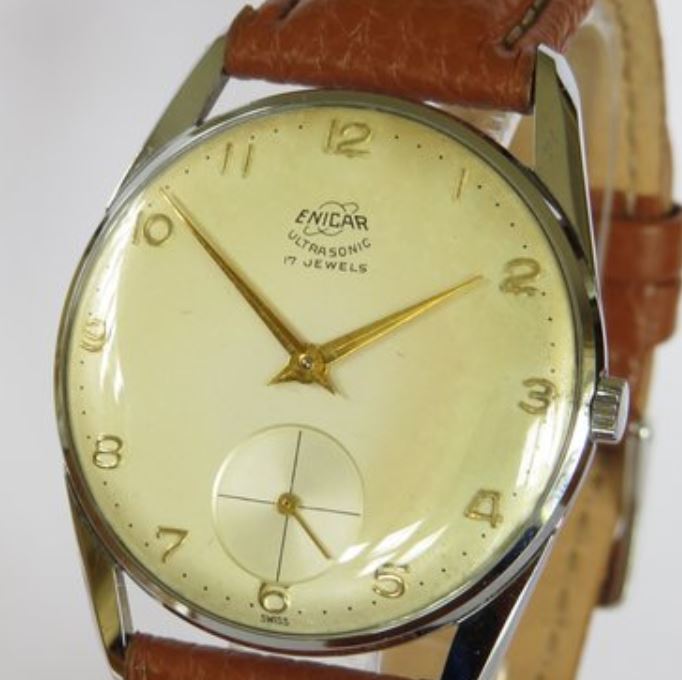
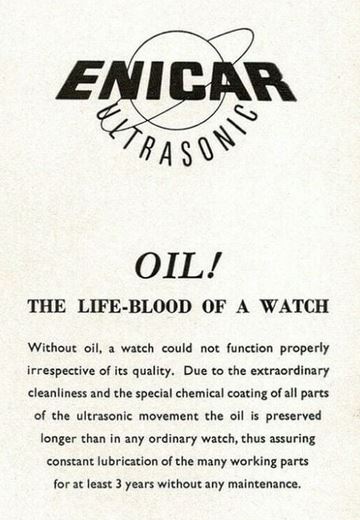
The mid-century period represented Enicar’s technological and commercial peak. Enicar invested heavily in advanced manufacturing processes. A new factory opened in Oensingen in 1953. Here, Enicar established its proprietary ultrasonic cleaning process. This cleaning technology ensured superior precision and reduced movement contamination.
Chronometer status
The manufacturing improvements supported improved chronometry standards. In 1954, Enicar received its first accuracy certificate. The Neuchâtel Observatory granted chronometer status to the Enicar 1010 17-jewel movement. Enicar also developed new waterproof cases. Its “Seapearl” waterproof wristwatch appeared in 1955 with a distinctive bayonet (oyster) case back. The Seapearl 600 model offered a water resistance rating of 600 feet (Enicar at Chronopedia).
In 1959, the Seapearl 600 underwent evaluation by the US Navy. It competed against heavyweight brands like Rolex and Blancpain. The model ultimately failed to secure the contract. The testing revealed deficiencies in the Seapearl 600. It lacked a crucial rotating timing bezel. This component was necessary for safely timing underwater operations. Additionally, the watch had excessive luminous material on the dial and a reflective case (Enicar Seapearl 600 at Worn & Wound).
The famous Sherpa line
In May 1956, a Swiss expedition to Lhotse and Everest wore Enicar Seapearl watches to the summits. The watches proved extremely reliable under those harsh conditions, so Enicar named the collection “Sherpa” in honour of the Nepalese guides. Mikrolisk shows that the name “Sherpa” was registered to Enicar SA on 6 November 1956. From that time, Enicar marketed Sherpa models for explorers and athletes. In total, it introduced over 100 Sherpa variants by the 1960s. The Sherpa line quickly made Enicar famous for rugged sports watches (Enicar Sherpa Graph line at Chronopedia).
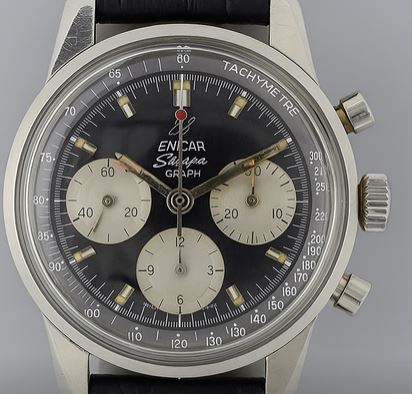
The Sherpa Graph Chronograph
The flagship Sherpa chronograph was the Sherpa Graph, introduced in 1960. It was Enicar’s motorsport chronograph, housed in a waterproof compressor case. The Graph remained in production through the 1960s (to about 1969). It featured the classic bi-compax dial with 30‑minute and 12‑hour counters. Race drivers such as Jim Clark and others regularly wore Sherpa Graphs, underscoring the model’s connection to motorsport (‘Jim Clark’ chronograph at WatchGecko).
The Sherpa Jet Graph
The Jet Graph was made for pilots and frequent travellers. In 1963, it launched the Sherpa Jet (36 mm) and Super-Jet (40 mm) models. These dual-crown watches had an internal 24-hour rotating bezel and a red GMT hand to track a second time zone. The early Mark I Jets (c.1963–66) used the AR1126 automatic GMT movement and had simple dauphine or paddle hands with red-tipped GMT pointers. In 1968–70 (Mk III), Enicar introduced bolder styling: the Jets offered colourful inner bezels and a distinctive red-and-black checkered 24‑hour GMT hand. The final Mk IV Jets (from 1970) featured chunky cushion-shaped cases (42×37 mm for Super-Jet/Jet) and used the AR166 GMT calibre (Enicar Sherpa Jet at Chronopedia).
Sherpa Dive series
In 1958, Enicar introduced Sherpa Dive models. These used EPSA “Super-Compressor” cases and came in two sizes: a 36 mm Super-Divette and a 41 mm Sherpa Dive. They featured dual crowns and an internal timing bezel for diving. The case backs were spring-loaded, tightening under water pressure to give roughly 600 ft (200 m) water resistance despite the lack of screw-down crowns.
The Aqua-Graph chronograph appeared in 1966. This was Enicar’s premier diving chronograph model. The watch used a 40mm steel case diameter. It featured a wide, double rotating bezel graduated to 60 minutes. The case back included an engraved oyster with a pearl. The Sherpa Ultradive model also remains highly sought after. This model similarly featured the dependable Super Compressor case.
Other Sherpa models
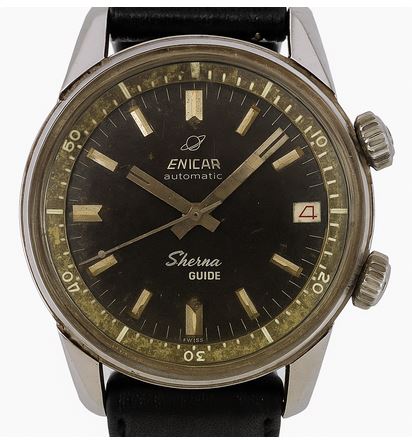
The Sherpa name was applied to many specialised models as well. For example, the Sherpa Guide (c.1960s) was a combination world-time/GMT/date watch. It had a dual-crown 24-hour bezel and city ring so the wearer could read two time zones and set world times. The Guide’s dial was largely black with a prominent yellow day-sector on the 24h scale for legibility. Enicar also offered pilot models called Sherpa Steward and Stewardess (for crew), as well as certified “Sherpa Chronometer” editions. All these Sherpa watches emphasised legibility and ruggedness, often with high-contrast dials and luminous hands suitable for exploration (Enicar Sherpa Guide at Chronopedia).
The decline of Enicar
Like many Swiss brands, Enicar struggled in the 1970s during the Quartz Crisis. The original company was forced into bankruptcy in 1987, marking the end of the vintage era. Today, the Enicar Sherpa range retains the most interest amongst collectors. In 1988, an investor in Hong Kong purchased the Enicar brand name rights.
Summary
What do we now think of Enicar and their Sherpa range? An interesting story for sure, but not enough for us to include a Sherpa in our collection. Perhaps, if we were given one, it might spend some time on the wrist. However, typically, we avoid complications beyond a simple date function. The cost of servicing and maintaining a chronograph or a vintage dive watch is simply too much to consider. That said, there is an active collectors’ market out there for the Enicar Sherpa range, and they sell for thousands of pounds, so what do we know?
Related content
Understanding the different Enicar Sherpa Graph executions at Fratello.
Leave a Reply