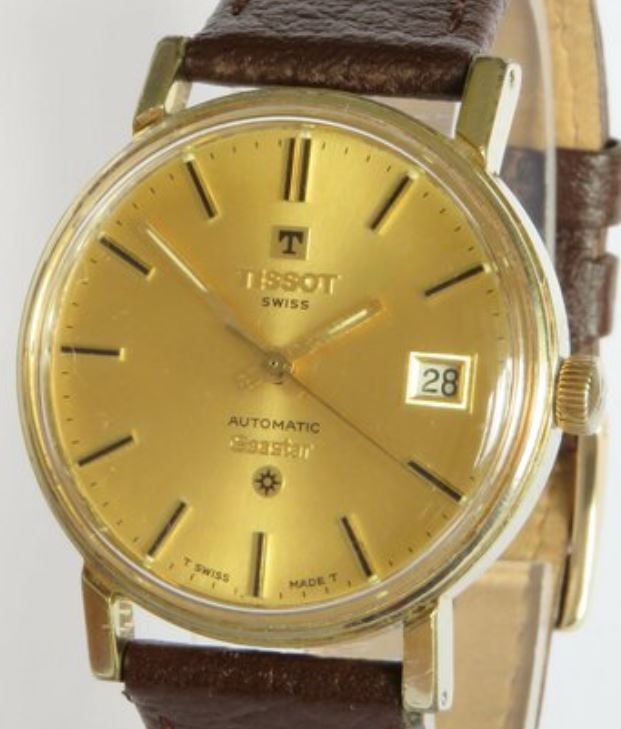
At Set Back in Time, we are fans of Tissot. The brand has history, respect amongst collectors, and offers a genuine entry-level point into the world of Swiss watchmaking. Reliable movements mean Tissot vintage watches can last for generations with regular maintenance. This particular Tissot Seastar automatic has been recently acquired by one of the Set Back in Time group, and we thought we would take this opportunity to share what we have learnt about this watch.
A brief history of Tissot
In 1853, Charles-Félicien Tissot and his son Charles-Émile established a watchmaking workshop in the Swiss town of Le Locle. Tissot initially focused on producing high-quality pocket watches. In 1858, Charles-Émile travelled to Russia and secured permission from the Tsar to sell Tissot timepieces throughout the Russian Empire, making it a major market. The brand underwent a significant transformation in 1915, shifting its focus to producing wristwatches. Between 1920 and 1977, Tissot designed and manufactured its own in-house movements (Tissot at Chronopedia).
To navigate the fallout of the 1929 market crash, Tissot joined forces with Omega in 1930 to create the SSIH Group. This was a partnership that eventually evolved into the modern Swatch Group. The merger allowed Tissot to produce movements of the same quality as Omega, offering identical mechanical standards within a different price bracket. In 1953, Tissot marked its centenary with the release of the Visodate automatic watch featuring a date window. Modern Tissot is an entry point to Swiss watchmaking, offering a mix of heritage, quality, and affordability.
The Seastar range
In the early 1950s, Tissot had designed an improved hermetically sealed “waterproof” watch case. The creation was airtight thanks to a double case back, and Tissot decided to call it Seastar. According to Mikrolisk, Tissot & Fils registered the trademark (Tissot Sea Star) in 1952.
The Seastar collection consisted of a range of elegant, water-resistant watches suitable for outdoor activities. In the 1950s, watches were rarely considered water-resistant. Swimming and showering were not possible with the average watch. The Seastar and others, such as the Omega Seamaster, rewrote the rules. The Tissot Seastar was a watch that could remain on your wrist through day-to-day activities, including showering or swimming at the beach. In the 1960s, the Seastar Seven took a step further forward. The watch used a reinforced crystal and a monoblock stainless steel case, further improving the water resistance.
Tissot produced the Seastar in high volumes, across a wide range of models. There’s the Seastar Seven, the Visodate, the T12, chronographs, and super compressors. Many Seastars used in-house movements, like the automatic Tissot calibre 2481 or calibre 784 (EmmyWatch database). Hand-wound models used movements such as the Tissot 782-1 calibre. Most models had a date complication (Visodate), and some included a quick-set or semi-quick-set date function.
The starburst logo
In the late 1960s, the Seastar line had evolved dramatically. To visually reinforce the Seastar name on the dial, Tissot introduced the multi-pointed starburst enclosing a circular core. This distinctive dial logo carries a dual meaning for watch collectors. The outer points of the emblem resemble a stylised maritime compass rose, which anchors the timepiece to ocean navigation, sailing, and an aquatic lifestyle. The solid circle at the absolute centre of the star symbolises the tightly sealed crown and caseback axis, which keeps moisture and dust entirely locked away from the delicate internal movement. During this era, Omega and Tissot closely shared production factories and movement development under the SSIH group. While Omega relied on its famous Hippocampus horse to symbolise water resistance, Tissot used this printed dial starburst to communicate the same protective capability to its wearers.
The starburst logo was applied using a printing technique known as pad printing or tampography. A silicone or rubber pad was pressed down onto a metal plate containing an etched ink template of the logo. This wet design was picked up by the pad, which was then pressed onto the dial. This paint was then baked and sealed beneath a protective layer of clear lacquer (Pad printing at Wikipedia).
Tissot 784-2 automatic movement
The Tissot 784-2 automatic movement was in production from 1967 to 1972. According to the Ranfft database, it features an excenter regulator and optional plastic bushings instead of dial screws. The movement is automatic, with sweep seconds and a date function. It features an early form of quickset date. Winding the hands forward to midnight, then backwards to 9.30 pm, and then forward again changes the date. In addition, it includes Incabloc shock protection, a frequency of 18000 vph and a power reserve of 45 hours. As well as the Seastar, this movement is found in vintage Tissot models such as various PR 516 and Visodate watches. The movement is fully signed and has the Tissot serial number 14,235,355, which dates it back to 1972.
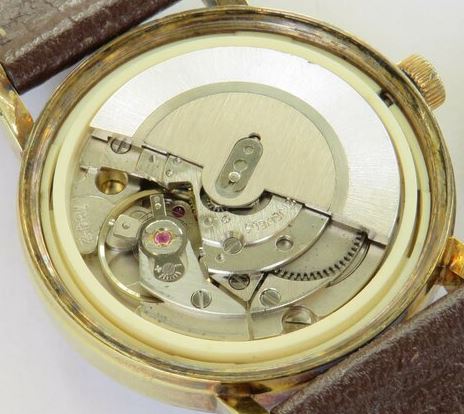
The calibre 784-2 was a workhorse movement based on Tissot’s manual-wind calibre 781, but with added automatic winding and date display.
Case and dial
The watch measures 34mm in diameter, excluding the signed Tissot winding crown and the lugs. The case is gold-plated, and the screw-on case back is stainless steel. The case reference number is 44521-1. The base number 44521 indicates a vintage Tissot Seastar / Seastar Seven automatic watch from the late 1960s to early 1970s. The trailing -1 confirms the specific dial configuration and case metal. In this case, a gold-plated case style configured for the Calibre 784-2 movement.
The Tissot “T” at the 12 o’clock position features the raised metal block logo with a sandblasted finish inside a square. This style of logo replaced the earlier “Sweeping T” in the 1960s. At the 6 o’clock position, the “Seastar” script sits above a multi-pointed starburst that symbolises the watch’s water resistance. Finally, the “T SWISS MADE T” branding below indicates that the watch uses Tritium as the luminous material on the hands and hour markers.
Summary
The watch is in good condition overall and keeps time within acceptable limits for a vintage watch. The leather strap that came with the watch has been replaced by a new Tissot strap. This includes a Tissot buckle. Most vintage watch collectors know that original leather straps and buckles are rare. We think the new owner hopes that in 20 years the new buckle will have acquired enough patina to pass for the original.
Leave a Reply