The Helvetia name has an interesting past. The story starts in 1848 when Louis Brandt opened a workshop in La Chaux-de-Fonds. The Brandt family moved the business to Bienne in 1880 to use better facilities and grow from a small workshop into a real factory. While the Brandt family eventually focused their efforts on Omega, they actually registered the Helvetia name in 1892, two years before they registered the Omega trademark. The name refers to the female personification of Switzerland, making it a very patriotic choice for a Swiss watchmaking firm.
The General Watch Company
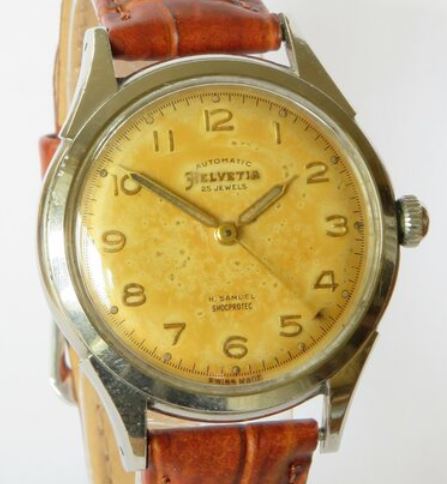
In 1895, the Brandt brothers joined forces with Edouard Boillat of the ébauche firm Ed. Boillat & Cie to establish a new venture in La Chaux-de-Fonds. This company was known as “La Générale” in French or “The General Watch Company” in English. It is believed that the Brandt brothers intended this company to manufacture lower-to-mid-range timepieces, so that they could focus on their higher-end brand, Omega. The most famous “brand” produced by Société d’Horlogerie La Générale was Helvetia.
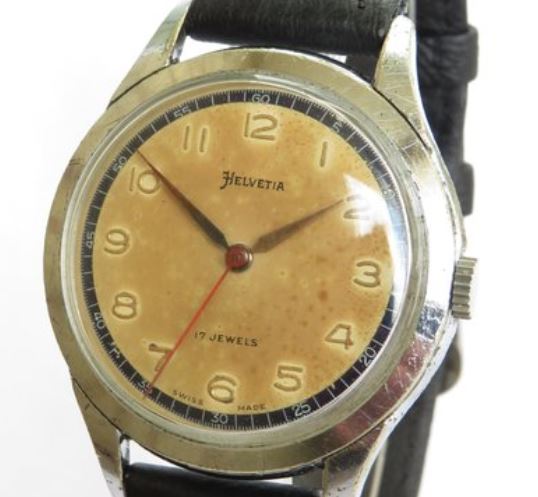
In the years that followed, the Brandt brothers produced Helvetia and Omega pieces in the same building. However, the Brandt brothers left The General Watch Company in 1911 to concentrate their attention on their premium line, Omega. This move gave The General Watch Company the freedom to build its own reputation in watchmaking over the following decades. However, by the late 1920s, The General Watch Company began to shift towards using ‘The Helvetia Watch Company’ as its primary trading name. This shift marked a new era for the business as it consolidated its identity under the Helvetia brand (Helvetia at Chronopedia).
Innovations
The Helvetia company entered a very creative period during the 1930s. They did not just follow trends but often led them. In 1929, they patented a shock protection system for the balance staff, which you can recognise in their movements by a three-legged or star-shaped spring. This made their wristwatches much tougher for active users like miners and soldiers. In 1932, they introduced the first big date watch using their Calibre 75 movement, which displayed the date through two separate discs. This design proved so successful that they sold the movement to other famous firms. Around this time, they also launched large 41mm pilot watches that featured rotating bezels and a spinning propeller logo on the dial.
Military watches
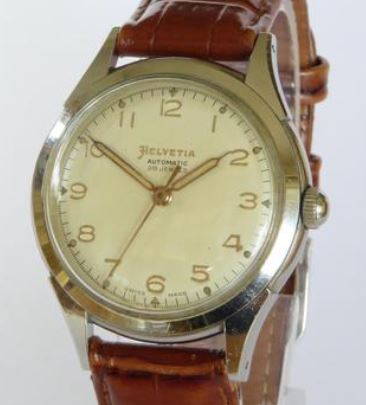
When the Second World War arrived, the factory became a major military supplier. They are well known among collectors for the DH watches they produced for the German army, which had to meet strict requirements like black dials and waterproof screw-back cases. They also provided pocket watches for the British Royal Navy. After the war, they reached their commercial peak in the 1950s. They produced around 90,000 watches a year by the end of that decade and built high-quality in-house movements like the Calibre 830 and their first automatic, the Calibre 836.
Ultimate demise
The 1960s and 70s presented the same difficulties that faced the entire Swiss watchmaking industry. They tried to keep up with models like the Waterstar and a diver that included a mechanical depth gauge. In 1968, they joined a group called SGT to share resources and helped bring the first watch with an LCD display to the market in 1972. However, the rise of Japanese competition proved too strong. The Bienne factory closed in 1973, and the SGT group finally dissolved in 1981.
Leave a Reply