Longines is one of the most underrated names in Swiss watchmaking. It may not always command the same attention as some of the more high-profile luxury brands. However, Longines has a legacy that is difficult to ignore. Founded in 1832, it holds the distinction of having the world’s oldest watch logo still in continuous use: the iconic winged hourglass. This emblem represents almost two centuries of technical achievements, elegant design, and innovation. This is particularly so in aviation chronographs, which were essential tools for early 20th-century pilots. Despite its lower profile in mainstream watch circles, Longines has built a dedicated following among collectors who appreciate its combination of heritage, craftsmanship, and value. At Set Back in Time, we are part of that following.
The mid-century Golden Age
Longines truly hit its stride in the mid-20th century, a period many consider its golden age. The brand produced a series of movements that are still regarded as some of Switzerland’s finest. While it may be ambitious to compare them directly to the rarified calibres of Patek Philippe or Vacheron Constantin, Longines was certainly not far behind. The company’s in-house manual-winding and automatic movements were consistently praised for their durability, smooth operation, and meticulous finishing. Open the case back of a vintage Longines, and you might find beautifully bevelled edges, Geneva stripes, or other hallmarks of traditional Swiss craftsmanship (The Invention of the Wristwatch at SwissWatchExpo).
Longines also played a pivotal role in advancing chronograph technology. The brand dedicated considerable resources to refining the wristwatch chronograph, particularly for aviation. One of its most famous collaborations was with Charles Lindbergh, who helped develop the Hour Angle watch. This was a highly precise tool for calculating longitude during flight. These pioneering pilot’s watches now command premium prices. They stand as a testament to Longines’ technical ingenuity at a time when aviation was pushing the boundaries of human achievement (Longines at Grail Watch Wiki).
Significant models
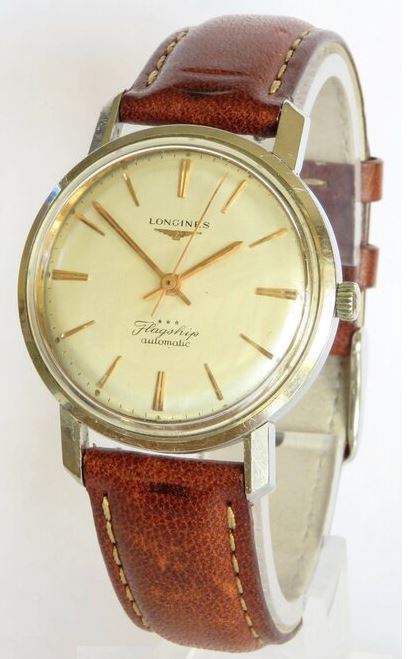
The 1950s saw Longines introduce its first named collections, including Conquest, which featured refined dress watches with automatic movements. The Flagship collection, launched in 1957, became known for its elegant gold cases, dauphine hands, and high-grade movements. In the 1960s, Longines balanced mid-century minimalism with sportier designs, introducing the Skin Diver. It was Longines first dive watch with a rotating bezel and 100-metre water resistance. The Ultra-Chron, released in 1967, featured a high-beat movement of 36,000 vibrations per hour, ensuring exceptional accuracy (Longines Ultra-Chron at Chronopedia).

Timeless design and elegance
Beyond its mechanical excellence, Longines has always been known for its restrained yet sophisticated design. Many mid-century watches can feel overly ornate or embellished, but Longines consistently achieved a balance of elegance and clarity. The dials are typically clean and understated, with slender baton or dauphine hands and well-proportioned numerals. Even the more decorative models from the 1930s and 1940s maintain a sense of harmony, whether through elongated rectangular cases with subtle details or round profiles that exude effortless simplicity.
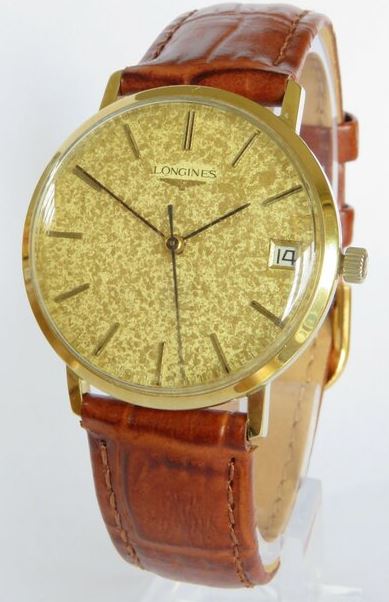
A quick browse through reputable vintage watch dealers reveals the breadth of Longines’ past production. The 1930s saw the brand embrace Art Deco influences, with rectangular cases, stepped bezels, and sector dials. The 1940s brought functional wartime designs, military-style watches in stainless steel with luminous hands and highly legible dials. By the 1950s, Longines leaned into mid-century refinement, producing slim gold dress watches with sunburst dials and automatic movements. The 1960s merged minimalist elegance with performance, introducing sporty models like the Longines Skin Diver. Many vintage Longines watches still feature original dials that have aged into a beautiful patina, some of which have developed desirable “tropical dials”. Others remain in remarkably pristine condition, a testament to their enduring build quality (Longines at Watch Wiki).
Exceptional quality without the premium price tag
One of the most compelling aspects of vintage Longines is its relative affordability. Certain high-profile Swiss brands command astronomical prices. However, Longines offers an incredible level of craftsmanship at a fraction of the cost. Collectors are often surprised at just how undervalued these watches remain, especially when considering their quality of finishing, materials, and in-house movements.
This affordability makes Longines an excellent entry point into the world of vintage watches. For those just beginning to explore mechanical timepieces, a vintage Longines offers a genuine slice of Swiss watchmaking history without requiring a huge financial commitment. Better still, Longines movements are known for their reliability, making them a practical choice for everyday wear, provided they have been properly serviced. Owning a vintage Longines means experiencing the pleasure of a well-crafted mechanical watch while knowing that it has been built to last.
Why vintage Longines deserves your attention
While Longines may not yet enjoy the mainstream hype of some other brands, seasoned collectors have long recognised its value. Some have even dedicated their collections entirely to Longines, showcasing the vast range of designs the brand has produced over the years. These enthusiasts appreciate details such as historically documented serial numbers, an array of case shapes influenced by Art Deco and Bauhaus design, and the impressive chronograph calibres that remain technically impressive even by today’s standards (Longines serial number).
Many collectors also appreciate the historical significance of Longines timepieces. Whether it’s a 1940s military-issued watch or a 1950s chronometer, each piece represents a moment in watchmaking history. Unlike some brands where vintage models can feel unattainable, Longines still offers the possibility of finding rare and desirable pieces at reasonable prices. This growing appreciation means that while Longines watches remain accessible now, they may not stay that way forever.
The perfect blend of heritage and affordability
What sets Longines apart is its ability to deliver exceptional quality, both in mechanics and design, at prices that remain refreshingly reasonable. Whether it’s an elegant gold dress watch from the 1950s or a bold aviation chronograph inspired by early flight, each Longines watch connects its wearer to a legacy that spans nearly two centuries. The winged hourglass logo is more than just a symbol. It represents a deep-rooted commitment to precision and design.
If you haven’t yet explored the world of vintage Longines, now is the perfect moment to start. These watches offer a rare combination of quality, history, and affordability. This is ideal for both those taking their first steps into vintage collecting and seasoned collectors looking for hidden gems. With their ageless charm, well-engineered movements, and designs that never feel outdated, vintage Longines watches prove that true watchmaking excellence doesn’t have to come with an exorbitant price tag.
Related content
The Longines official website.
Leave a Reply