Roamer is not a name that immediately springs to mind when talking about vintage watches. However, it does have a long and reputable history. At one of the regular Set Back in Time meeintgs, this Roamer Anfibio was loudly ticking on a guest’s wrist. We took some time to research the history of the Roamer brand an the Anfibio model. Below is what we uncovered.
A brief history of Roamer
Fritz Meyer established a small watchmaking workshop in Lengnau, Switzerland, in 1882. However, the venture soon failed. Meyer found employment at Uhrenfabrik Langendorf SA, where he observed Karl Kottman’s successful leadership. Inspired, Meyer started a new, workshop in Solothurn in 1888, focusing on budget cylinder escapements. By 1895, Meyer employed 60 staff and began assembling complete watches. The company created its first in-house calibre, the reliable “38”, in 1897.
In an effort to expand the business, Meyer partnered with Johan Studeli in 1905, forming the company Meyer and Studeli, or MST. By 1906, MST employed 120 staff and built a large new factory in Solothurn. They focused production on low-priced cylinder movement watches.
The Roamer brand
In 1917, MST acquired L Tieche-Gammeter (LTG), a company famed for producing quality lever escapements under brand names like Roamer. This acquisition allowed MST to introduce a premium line of higher-quality lever movement watches. By 1918, MST became the limited company Meyer & Studeli SA. According to Mikrolisk, MST registered the Roamer trademark in 1918. Roamer was to serve as the premium line of superior jewelled lever movements (Roamer at Watch Wiki).
By 1923, MST were producing all their own cases and movements entirely in-house. The business successfully navigated the economic challenges of the Great Depression. The company formally changed its name to Roamer in 1952 after the success of its premium line. Roamer continued manufacturing timepieces until the 1970s, when it succumbed to the Quartz crisis.
Roamer Anfibio
The Roamer Anfibio (Spanish for amphibian) was designed with water resistance in mind. According to Mikrolisk, Meyer & Stüdeli SA registered the trademark “Roamer Anfibio” in 1953. Roamer officially launched the Anfibio brand in 1955.. Period advertising describes the “waterproof” case as:
“The secret of these 100% waterproof models lies in the patent ROAMER case with the special rim glass. A sealing ring-the most frequent cause of leakage-is dispensed with in this design. The patent case guarantees an absolutely tight seal, even after the watch has been opened numerous times. A sealing ring, on the other hand, can obviously never be replaced in exactly the same position. Four-fold patented construction”.
MST 430 calibre
The MST 430 watch movement, was in production from 1961 to 1973. It is a hand-winding movement which features a date display and a centre sweep seconds hand. It includes a semi-quickset date function where moving the hands repeatedly between 9pm and 12 midnight changes the date. The movement also includes Incabloc shock protection for enhanced durability. It includes 17 jewels, a power reserve of 43 hours and a frequency of 18,000 vph (MST 430 at Ranfft DB).
Case and dial
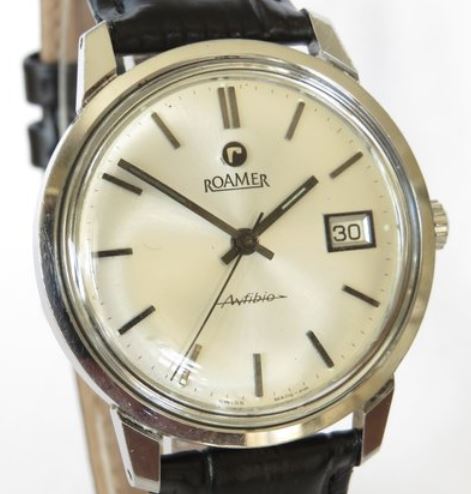
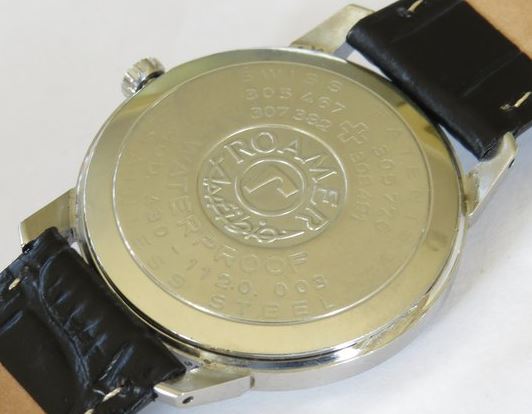
The watch measures 35mm in diameter excluding the winding crown and the lugs. Roamer made the majority of their own cases entirely in house from 1923 until its ultimate demise in the 1970s. The case back displays a list of Brevets (patents) relating to the water resistant case. The model number of this case is “430 112.0.005”. The 430 indicates the MST 430 movement, the 112 reflects the patented waterproof casing system and the use of stainless steel. The signed Roamer winding crown adds a touch of authenticity. The case back states that the watch is waterproof. However, as with any vintage watch, it should be kept away from water and moisture.
The case and lens (signed crystal) are in excellent condition. The signed dial is in good condition with original hands, seconds sweep and date display. The watch features a new leather strap. The movement runs for almost 40 hours after a full wind. That is only 3 hours down from the power reserve claimed in the production specification. This is perfectly normal for the mainspring to lose elasticity after many years in operation. The watch apparently runs at a very acceptable + 25 seconds per day. This is very impressive, considering the date of the last service is unknown.
Summary
The 1960s and 1970s was the golden era for Roamer vintage watches. Apart from the Anfibio, there were other significant watches in the Roamer range during this period. Mustang watches closely link to the Roamer brand’s racing heritage (Roamer sponsored the Indianapolis race track). Another wellknown line is the Roamer Rockshell series, which featured many ambitious and interesting designs. Roamer produced Stingrays between 1966 and 1975 featuring sportybold designs. This particular watch features a reliable Swiss mechanical movement (MST 430) and uses Roamer’s patented Anfibio waterproof case. An interesting timepiece and still very useable as a practical daily watch. However, Roamer is never going to be an “investment” brand in the vintage watch world.
Leave a Reply