At Set Back in Time, we’ve always felt that Omega is a brand that is right up there with the Holy Trinity (Audemars Piguet, Vacheron Constantin, and Patek Philippe), but isn’t pretentious. It’s an accessible brand for many people, with good quality, reliable vintage timepieces that don’t break the bank. We also like the history of Omega, especially that of the Speedmaster and the Seamaster. And when you see someone wearing an Omega, you know that they appreciate quality watchmaking and are not just using the brand to show off to others. We thought we knew most of the Omega range, until recently, when we came across this example of the Omega Seamaster Cosmic, dating back to the 1960s. The “modern” style looks a bit awkward to me, and we couldn’t see ourselves strapping one on the wrist. However, we couldn’t resist exploring the history behind the Cosmic. Here is what we have found.
The origins of the Omega Seamaster Cosmic
The Omega Seamaster Cosmic was in production from 1966 to 1980. It was a strategic offshoot of the classic Seamaster collection. It was conceived to broaden the Seamaster’s appeal beyond its well-known diving watches and chronometer-grade pieces. Omega designed its accessible pricing and modern, “experimental” appearance to serve as an entry point for a younger, more style-conscious demographic.
The name “Cosmic” was not a random choice but a deliberate marketing ploy by Omega. Its primary purpose was to capitalise on the brand’s association with NASA and the space race. It was an unashamed attempt to share the limelight with the Speedmaster Professional “Moonwatch” (Space legacy at Omega).
Monocoque case
The Cosmic series is known for its innovative, though challenging, monocoque case design. It was a single-piece construction where the case back is fixed and cannot be removed. This design’s primary benefit was its enhanced water resistance. The one-piece design eliminated a common point of failure, the case back gasket. However, the movement could only be accessed from the front. This was a complex process that required special tools and a high degree of technical skill. This design presented a significant technical challenge, as it made routine service more difficult and costly. Omega wasn’t alone in experimenting with the monocoque design. Other brands, including Tissot, Cyma and Roamer, were also experimenting with monocoque cases during this era. This demonstrated the broader industry focus on improving water resistance.
Cosmic 2000
Omega introduced the Seamaster Cosmic 2000 series in 1972. This new line was characterised by a two-piece “case within a case” design. In this improved design, the watch movement and crystal were housed within a sealed inner container. This was then fitted into a synthetic sleeve and slotted with the outer case. This not only simplified repairs by allowing for easier access to the movement but also significantly improved the watch’s water resistance, doubling it from 30 metres to 60 metres. We did watch a YouTube video of a Cosmic 2000 restoration, and despite the “improved” case design, it still looked to be a difficult task to extract the movement.
Omega calibres
The Seamaster Cosmic line was powered by a range of reliable and well-regarded Omega calibres. Early models included manual-wind movements. This included the 17-jewel Calibre 601, which operated at a frequency of 19,800 (vph) and had a 48-hour power reserve. The manual-wind Calibre 613 featured a quick-set date function. The series also featured several automatic calibres, including the Calibres 552, 562, 565, and 752. The Calibre 562, a 24-jewel movement with a 50-hour power reserve and a frequency of 19,800 vph, was often certified as a chronometer. The Calibre 752 offered a day-date function. The later Cosmic 2000 generation introduced higher-frequency calibres, such as the 23-jewel Calibre 1012 and Calibre 1022. These automatic movements, which operated at 28,800 vph, featured a quick-set date and a hacking function for precise time setting (Omega calibres at EmmyWatch).
Discontinuation
The ultimate discontinuation of the Seamaster Cosmic was not a direct reflection of the model’s failure. Rather, it was a consequence of the widespread “Quartz Crisis” of the 1970s. This period of industry-wide turmoil forced Omega to undergo a drastic restructuring. It consolidated its product portfolio and focused on its most globally recognised and profitable lines, the Speedmaster and the Seamaster. However, today, the Omega Seamaster Cosmic stands as a uniquely affordable and unusual collectable. The downside would be the difficulty in servicing the watch.
1960s Omega Seamaster Cosmic
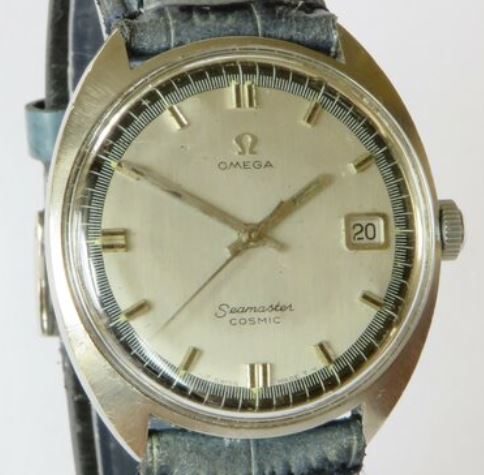
The watch has a hand-winding movement that keeps good time. It is a calibre 613, which is based on the calibre 563 minus the self-winding mechanism. Additionally, the movement has a quick-set date function. By pulling the crown beyond the time setting position, the date jumps forward one day. The regular date change occurs slowly between 23 and 24 o’clock. According to the Ranfft database, the movement has 17 jewels, Incabloc shock protection, a frequency of 19,800 vph and a power reserve of 50 hours. It was in production from 1967 to 1974.
The watch measures 34.5mm in diameter, excluding the winding crown and the lugs. The case is stainless steel, and it is in good condition with just light surface marking. It is the original monocoque design. The back of the watch has the Seamaster logo and the original owner’s name lightly engraved. It states that the watch is waterproof. However, as with any vintage watch, it should be kept away from water and moisture. The signed dial is in its original finish with original hands, centre seconds hand and date display. Additionally, there is light marking on the dial and a little distortion.
Conclusion
The case design of the Cosmic doesn’t really appeal to us. We like more of the classic Seamaster look. The dress-style gentleman’s watch, which was the original Seamaster. We couldn’t see ourselves owning a Cosmic, unless it was a gift. The longevity of the watch would be questionable given the difficulty in getting it serviced due to the monocoque case design. This is not to say we don’t appreciate the watch, but we just don’t see one on the wrist. We have been proven wrong many times before as vintage watch enthusiasts, and it has happened yet again. An interested collector snapped this watch within days. We hope they enjoy wearing their Seamaster Cosmic.
Leave a Reply