The Omega Constellation is named after the eight stars featured on its case-back medallion. The stars represent Omega’s eight world records set at the Kew-Teddington trials and the Geneva Observatory during the mid-20th century. The Constellation line was created specifically as Omega’s flagship chronometer collection, representing the brand’s commitment to precision and excellence. Every Constellation model, whether vintage or modern, has been officially certified for its chronometer-level accuracy. In this post, we explore the history of the Omega Constellation range.

A brief history of Omega
Omega’s story began in 1848, when Louis Brandt established a small workshop in La Chaux-de-Fonds, Switzerland. There, he assembled key-wound pocket watches using locally sourced components. Following Brandt’s death in 1879, his sons relocated the business to Biel/Bienne, where they modernised operations by introducing centralised and industrialised production methods. In 1894, the Brandt brothers unveiled the revolutionary “Omega” movement, notable for its interchangeable parts and outstanding precision. It was so successful that in 1903, the company officially adopted “Omega” as its name.
During the early 20th century, Omega expanded rapidly, earning international recognition as the official timekeeper of the Olympic Games beginning in 1932. The brand developed highly accurate wristwatches, marine chronometers, and aviation timepieces, and supplied reliable instruments to military forces during both World Wars. In 1957, Omega introduced three significant collections: the Speedmaster, Seamaster, and Railmaster. The Speedmaster achieved iconic status in 1969 as the first watch worn on the Moon, following NASA’s demanding qualification tests.
However, the Quartz Crisis of the 1970s and 1980s brought major challenges. Inexpensive Japanese quartz watches disrupted the market, eroding Omega’s profitability and prestige. By the late 1980s, the company became part of the Swatch Group, marking a new chapter in its history (Omega at Chronopedia).
The Omega Centenary
The Omega Centenary was introduced in 1948 to celebrate the 100th anniversary of the brand’s founding. It holds a special place in Omega’s history as the company’s first chronometer-certified automatic wristwatch. The design of both the Centenary and the Seamaster, launched the same year, was led by René Bannwart, who headed Omega’s “creation” department in Biel until 1955 (René Bannwart at Quill & Pad).
Originally produced in a limited run of just 6,000 pieces, the Centenary achieved remarkable success. Its popularity inspired Omega to develop a follow-up model that could be produced on a larger scale and stand as a full collection in its own right. This evolution led to the creation of the Omega Constellation, which made its debut in 1952.
The Omega Constellation
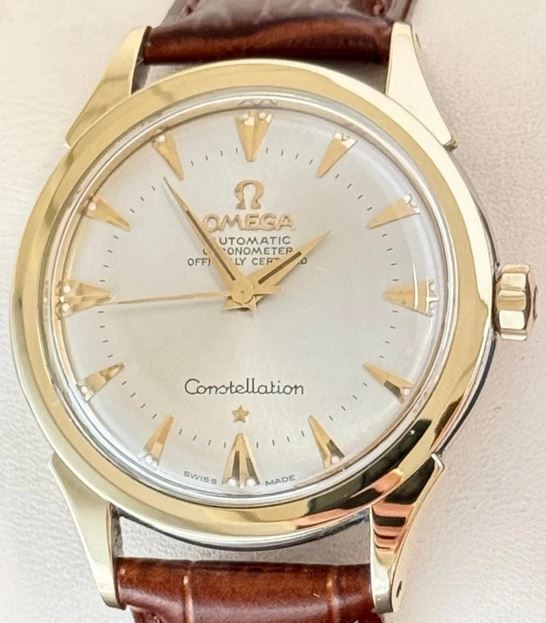
According to Mikrolisk, Omega registered the trade mark “Constellation” trade mark in May 1952. Omega launched the first Constellation watches with automatic movements and adjusted them to chronometer standards. Initially, Omega fitted them with “bumper” automatic movements (351, 352, 354) whose rotors swung back and forth instead of turning a full circle. These early models often featured solid gold or gold-capped cases and bracelets.
The “Pie-Pan” dial
The twelve-faceted “Pie-Pan” dial became one of the watches’ signature aesthetic features: a flat centre surrounded by an angled outer ring, which resembled an upside-down pie tin. The Pie-Pan dial, along with applied arrowhead indices and a faceted crown, gave the Constellation its distinctive 1950s appearance. By the late 1950s, Omega had also introduced full-rotor chronometer calibres (such as calibre 561 and 564). This enhanced reliability while continuing the collection’s focus on precision (The Pie-Pan era at Goldammer).
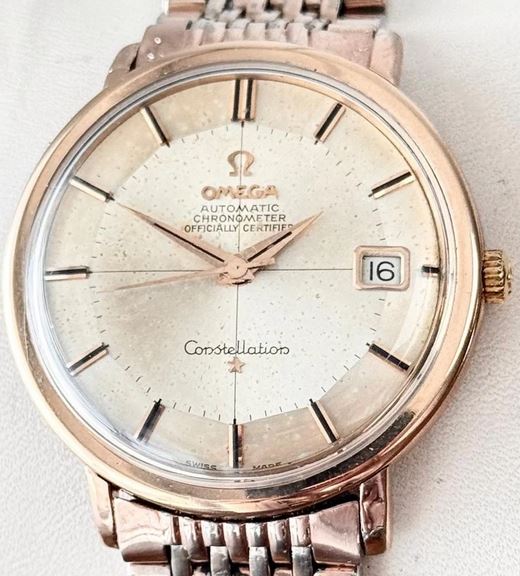
In the 1960s, Omega evolved the Constellation’s style and engineering. Many cases adopted new forms. Depending on the year, a Constellation might have elegant “lyre” lugs, sharp “dog-leg” lugs, or the signature curved C-shaped case introduced in 1964. Gérald Genta designed the 1964 C-shape case. This featured integrated lugs that made the modest 35mm case look larger and more modern. That same era saw Omega patent one of the earliest integrated bracelets: in 1969, Pierre Moinat’s design locked the bracelet’s end links into slots in the case. This made it impossible to fit any other strap (The history of the Omega Constellation at Monochrome).
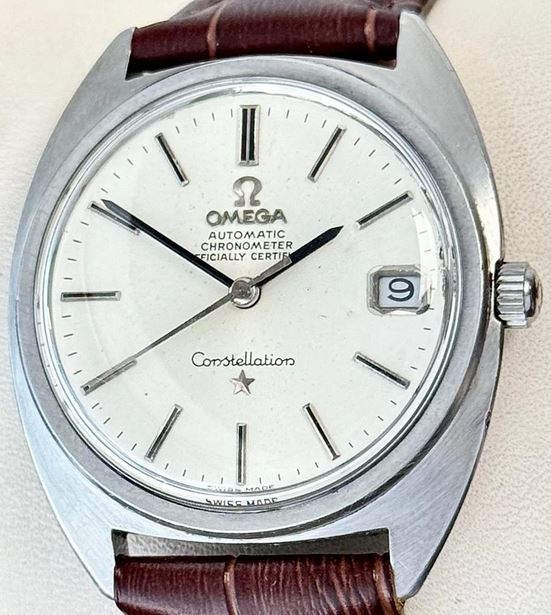
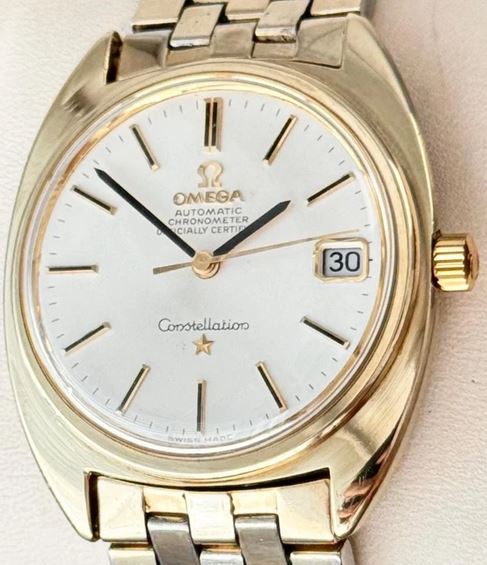
Constellations of the 1960s came in a variety of materials (stainless steel, yellow, white or rose gold, even platinum). The dial styles varied from flat sunburst designs to textured “waffle” patterns. They typically retained chronometer certification and robust automatic movements (Omega calibre 551/561 and later 564 and 752 in date models), which maintained the collection’s reputation for accuracy.
Quartz Crisis
The 1970s brought the Quartz Crisis, and the Constellation adapted accordingly. At Baselworld 1970, Omega unveiled the first quartz Constellation, the Electroquartz, which was powered by the Beta 21 quartz calibre. These models possessed a futuristic character and attracted a luxury price (for example, an early Electroquartz cost as much as a new Volkswagen). In the late 1970s, Omega introduced ultra-precise quartz movements, including the Constellation Megaquartz 2.4 MHz, which offered accuracy far beyond mechanical norms. By the mid-1970s, chronometer-rated quartz models largely supplanted the traditional mechanical Constellation. Additionally, the pie-pan dials gave way to flatter modern designs. Notably, Omega still applied its chronometer standards to these quartz models. This meant that even electronic Constellations received precision certification (Omega Electroquartz at Wikipedia).
The “Manhattan” design
In 1982, Omega gave the Constellation its most famous makeover with the “Manhattan” design. Carol Didisheim conceived the Manhattan case, which was ultra-slim and featured a sleek integrated bracelet. Four prominent claws at 3 and 9 o’clock became its hallmark. Originally, these claws served as clamps to secure the crystal and ensure water resistance in a thin case. The ultra-thin quartz calibre 1422 housed the first Manhattan models, setting the tone for the collection’s modern appearance. In 1984, Omega reintroduced automatic movements to the Constellation (using a chronometer-rated calibre based on the ETA 2892). This gave buyers the choice of quartz or mechanical (The Omega Constellation at Fratello).
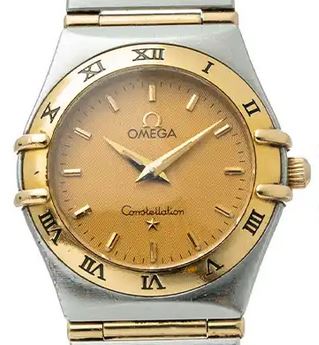
Throughout the 1980s and 1990s, Omega offered the Constellation Manhattan in many sizes and materials (steel, gold or two-tone). Despite these changes, it firmly remained a chronometer-certified luxury watch. During this era, sapphire crystals became standard. Additionally, by the mid-1990s, the applied Roman numeral hour markers moved from under the crystal onto a flat bezel. This cosmetic update created the modern look still used today.
By the end of the 20th century, the Constellation had evolved from a classic mid-century dress chronometer into a distinctive luxury line with both quartz and automatic models. Its signature elements, the star observatory medallion, the pie-pan heritage, and later the “Manhattan’s claws” and integrated bracelet, ensured continuity even as technology and fashion changed.
Summary
Although chronometer certification was a core, defining feature of the Constellation line from its inception. However, there were exceptions, particularly with the introduction of various quartz movements and specific modern sizing options. In short, while the Constellation represents Omega’s commitment to precision, historically, not every single model produced has carried the official “Chronometer” designation.
The Omega Constellation range is an ongoing tribute to Omega’s precision achievements at the Geneva Observatory and its history of participating in observatory trials. It combines exquisite design with exceptional precision. Since its introduction in 1952, the Constellation line has been synonymous with elegance, quality, and Omega’s commitment to producing highly accurate timepieces.
Related content
Omega Constellation at Omega Chronicle.
Leave a Reply