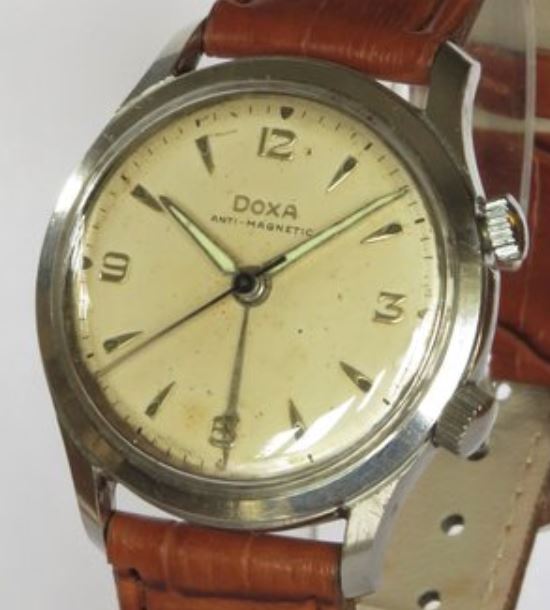
In a recent Set Back in Time meeting, a regular brought along an out-of-town guest. In itself, that is not unusual. Our meetings are open to anyone happy to talk about watches. However, in this instance, the guest was wearing a Doxa Cricket alarm watch dating from the 1950s. Most of us admitted that we had not seen a vintage alarm watch before, and the watch became the focus of this post.
Everyone uses a smartphone today. These mini computers in our pockets do everything. Consequently, many see no point in wearing a watch, but if you’re reading this, we doubt that applies to you. However, imagine what it would have been like in the 1950s if you saw a watch that not only told the time but featured an alarm? The Vulcain Cricket was the first wristwatch to achieve precisely that.
Vulcain – the first practical alarm watch
Jacques Ditisheim established ‘Manufacture Ditisheim’ in La Chaux-de-Fonds, Switzerland, in 1858. The company renamed itself ‘Vulcain’, after the Roman and Greek god of fire, in 1894. Like many manufacturers of the time, production focused mainly on pocket watches. Vulcain entered the wristwatch market comparatively late, only producing watches for military use in the 1940s.
The Cricket is undoubtedly Vulcain’s most recognisable model, and it has remained in continuous production for many years. Robert Ditisheim, determined to create a practical alarm wristwatch, began development on the alarm calibre in 1942. Other watchmakers had attempted to create alarm wristwatches in the past. However, the watches were too quiet for any practical use.
The primary problem involved raising the volume of the alarm in such a limited space. Wearing the watch made the issue worse, as the wrist absorbed the sound. After five years of development, the company, working in conjunction with a casemaker, finally patented a design that created a resonating skin inside an echo chamber. The resulting alarm was a loud, ‘cricket-like’ sound.
The rest of the Swiss watch industry quickly followed. Watch brands featured the alarm complication in some form throughout their catalogues in the late 1950s and early 1960s. The A. Schild calibre AS 1475, a generic or “off the shelf” alarm movement created in 1954, was one of these solutions. For brands like Tudor, Tissot, Benrus, Bulova and Doxa, it made it simple to add an alarm to their offerings.
AS 1475 movement
The AS (A. Schild) 1475 is one of the best-known mechanical movements that feature an alarm. The AS 1475 includes two spring barrels (one for the alarm, one for the watch) and two crowns. It is a manual-wind alarm movement that features a sweep second hand and an alarm function. The basic model has 17 jewels. However, 18, 19 and 21 jewel versions also exist. It has a power reserve of 46 hours, Incabloc shock protection, a glucydur compensating balance (non-magnetic), a flat hair spring and a frequency of 18,000 vph.
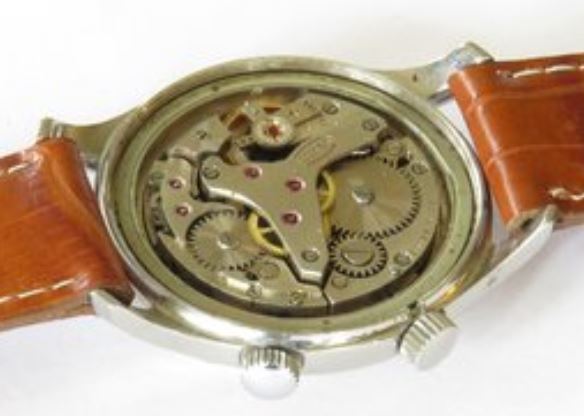
The movement was produced from 1954 to 1970 and included various modifications throughout its manufacturing period. These included a date function and a faster balance before. These variants went out of production around 1974. The Russians copied the design, and the 1st Moscow Watch Factory (Poljot) produced their version of the movement. The AS 1475 was one of the most widely produced alarm movements, with over 781,000 made, excluding those produced in Russia.
Two crowns
The upper crown is used for setting, winding and activating the alarm. The hand is moved backwards until the desired alarm time is reached. The alarm is then wound up via the same crown, and the crown is pulled out to set. To stop the alarm, the crown is pushed in. The alarm has a 25-second power reserve. The Lower crown operates as per a normal wristwatch. The watch is wound by turning the crown clockwise in the starting position. To set the time, the crown is pulled out and rotated anti-clockwise.
You can hear a sample of the alarm by clicking on the audio player below.
In case it’s not clear by now, the “Cricket” name was chosen because the sound is reminiscent of the chirping of a cricket.
Doxa, a brief history
Georges Ducommun (1968 – 1936), the founder of the Doxa watch company, was born in Le Locle, Switzerland. Ducommun began his apprenticeship in 1880 and, by 1889, at just 21 years old, started his own business as an independent watchmaker. He quickly built a solid reputation for excellent customer service and attention to detail, eventually creating the Doxa brand, a name which means ‘glory’ in Greek. According to Mikrolisk, Ducommun registered the Doxa trademark in 1902. Ducommun’s craftsmanship gained swift international recognition. The anti-magnetic watches, which he developed in the early 1900s became the hallmark of his company.
Ducommun’s ingenuity was evident during the early 20th-century automobile revolution when motor racing required reliable timing instruments. He developed a robust and reliable dashboard-mounted timepiece with an appropriate power reserve. In 1908, he patented the “8-Day Doxa Caliber,” which subsequently became standard equipment on Bugatti racing cars. Following Georges’ death in 1936, his son-in-law took over the firm. Unlike many of its contemporaries, Doxa survived and continued to innovate, notably in the 1960s when the company developed a range of quality dive watches. The company still exists, although it has changed hands several times since the Quartz Crisis of the 1970s.
Case and dial
The watch measures 34mm in diameter, excluding the crowns and the lugs. The case is stainless steel, and it is in good condition with just light surface marks and some unevenness to the case back. The case back is signed with the Doxa name, and says “WATERPROOF, SHOCKABSORBER and ANTIMAGNETIC”. Although the case back does state it is waterproof, as with any vintage watch, it needs to be kept away from water and moisture. The lens is in good condition. The dial is signed “DOXA, ANTI-MAGNETIC”. It has the original hands, including the additional “alarm” hand. The dial has a little light marking, but nothing more than age-related patina. The watch has a new leather strap, including a plain buckle.
Summary
The Doxa Cricket alarm watch is a very interesting timepiece and the first of its kind that any of us had seen. As a practical alarm, it would work. Although we all admit that it is a slightly irritaing wake up call. The downside of this watch would be the ongoing servicing costs to maintain the alarm. Any complication is going to add to maintenance costs. In this case, you would probably opt for the alarm on that smartphone in your pocket.
Related content
History at the Doxa website.
Leave a Reply