Camy Watch Co. SA remains one of the more “obscure” brands of the 20th-century Swiss watchmaking industry. They are readily available online, but they are not recognised as a household name amongst vintage watch collectors. This is despite reaching a production peak of 1.5 million watches a year. The company eventually dissolved, leaving behind a history with links to some significant watchmaking names of the 20th century.
The history of Camy Watches
The Stroun brothers, Maurice, Samuel, and Naum, established a watchmaking factory in 1913 in Grenchen, Switzerland. Originally from Polotzk (in modern-day Belarus), the brothers initially operated under the name “Stroun Frères”. According to Mikrolisk, they officially registered the Camy trademark in 1923. However, the company’s identity would evolve significantly over the coming decades.
While the brand originated in Grenchen, a major shift occurred in 1943 when Samuel and Maurice moved operations to Geneva and rebranded as “Camy Watch SA”. This move marked the beginning of the brand’s golden era. Camy positioned itself as an établisseur, a firm that sourced high-quality movements from specialist manufacturers like Ébauches SA (ETA, Valjoux, and Landeron) and housed them in their own cases. This strategy allowed them to produce reliable, stylish, and affordable watches for a growing global middle class.
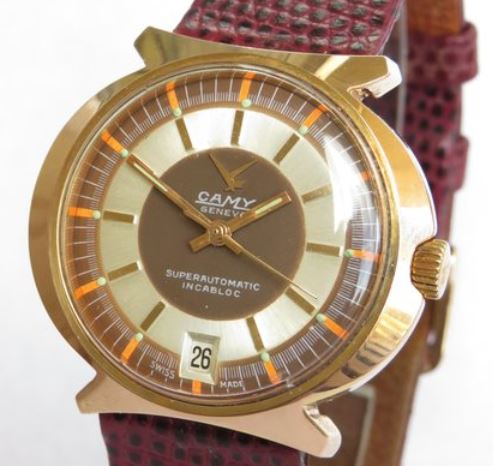
The post-war years saw Camy flourish, largely thanks to two pivotal figures, Raymond Weil and Simone Bédat. Weil joined the company in 1949, joined the Board of Directors in 1954, and eventually rose to the position of General Manager. For 26 years, he steered Camy through a period of immense growth and creative experimentation. Under his leadership, the brand became synonymous with the “Camy Geneve” signature (Camy at Chronopedia).
Innovations
The 1950s and 60s saw Camy embracing the era’s technical innovations. They were early adopters of the automatic movement and even experimented with the Landeron 4750, one of Switzerland’s first electric movements. In a peculiar marketing move during the late 50s, Camy participated in the “Jewel Wars,” producing watches with as many as 77 jewels to suggest superior quality. By the mid-1960s, Camy’s production had increased to the point that they were capable of manufacturing over a million timepieces annually.
Design-wise, Camy was “creative”. They produced everything from elegant “Royal” dress watches to rugged “Seven Seas” divers and “Rallyking” chronographs. In 1964, they even claimed, though it remains unverified, that the Russian cosmonaut Yuri Gagarin wore a Camy watch in association with a Vostok space mission.
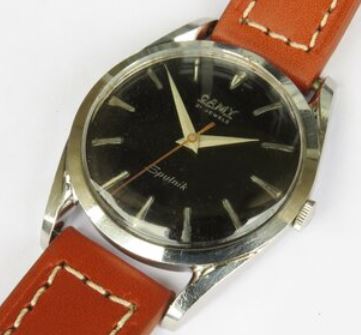
According to Mikrolisk, Camy registered quite a few trade names, predominantly in the 1960s and 1970s. These included: Airport, Challenger, Club Star, Digimatic, Dragon Eye, Eastern-End, Friendship, Geneva Tropicalised, Golden Jet, Green Bird, Happy Bird, Jet Prince, Jetport, Karate, Kings Club, Miner, Miss 22, Miura, Montego, Nerva, Popular, Punch, Queens Club, Rallyking, Reliable, Royal, Sea Club, Shaheen, Silver Cloud, Sun Bird, Surf King, Tivoli, Topkapi, and White Bird.
Quartz Crisis
However, the 1970s brought the “Quartz Crisis,” which devastated the Swiss mechanical watch industry. Internal friction also played a role. In 1975, following the death of Samuel Stroun, his son Jean took over. Tensions eventually led Raymond Weil to leave the company and start his own namesake brand, Raymond Weil Geneve. This departure stripped Camy of its most experienced leadership and many key employees. Although Camy attempted to modernise by producing LCD and LED watches, the company could not survive the combined weight of the quartz revolution and the loss of its visionary management. The firm eventually closed its doors in the late 1970s (Camy Watch Co. SA. at Kibble Watches).
Related content
The true story of Camy watches at Time2Tell.
Leave a Reply