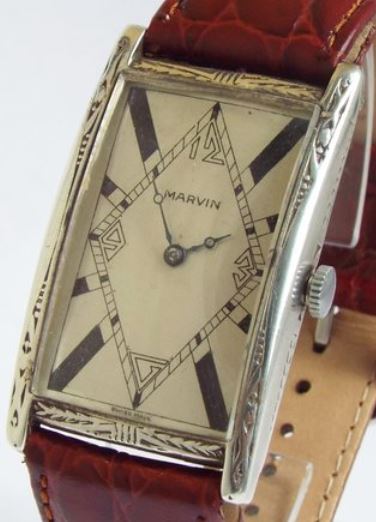
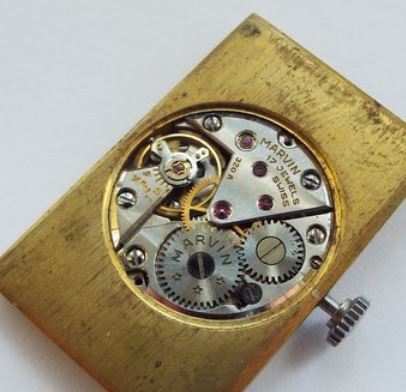
This is a striking Marvin wristwatch dating from the 1950s. This particular watch has a 17-jewel Swiss hand-winding movement, calibre 320A, which is working well. None of us at Set Back in Time have had much to do with the Marvin brand. We set aside some time to investigate the brand and this particular watch. Below is what we have uncovered.
The origins of the Marvin brand
In 1850, brothers Marc and Emmanuel Didisheim established a watchmaking factory in Berne, Switzerland. During these early years, the brothers focused on the assembly and finishing of watches using components sourced from external suppliers. By 1891, the family formalised their growing enterprise by registering the business under the name Albert Didisheim et Frères (Marvin at Grail Watch Wiki).
The Birth of the ‘Marvin’ Identity
As the company prepared to launch its products in the United States during the early 1890s, the founders realised that their Albert Didisheim et Frères name would lack recognition in the American market. Seeking a more suitable and recognisable identity, they adopted the name of their US agent, Marvin. This rebranding coincided with a major leap in technical capability. By 1912, the company had become a true manufacturer, producing all its components in-house. This vertical integration allowed Marvin to build a reputation for high-quality watchmaking at remarkably fair prices (Marvin at Catawiki).
In the 1930s, Marvin designed watches specifically for motorists. The first notable model was the Motorist watch. It was designed to be worn on the inside of the wrist so the driver could easily check the time without taking their hands off the wheel. In 1955, Marvin partnered with the Dutch airline KLM and produced a watch called ‘The Flying Dutchman’, naming the watch after the aircraft used by their new partner. Marvin created an elegant wristwatch for pilots alongside a clip-on version for stewardesses, which pinned neatly to their uniforms as a practical accessory.
Mid-Century glamour
By the mid-20th century, Marvin had become well known in the industry, largely thanks to a creative approach to promotion. The brand aggressively pursued motor sport sponsorships and secured endorsements from the era’s most iconic figures. High-profile celebrities, most notably Marilyn Monroe, famously wore Marvin watches. This cemented Marvin’s status as a symbol of mid-century watchmaking style.
The Quartz Crisis
Marvin reached its commercial and creative peak during the 1950s and 60s. However, the 1970s brought with it the “Quartz Crisis”, a period that fundamentally changed the entire Swiss watch industry. As the market shifted rapidly towards battery-powered timepieces, many traditional houses faced existential threats. Consequently, the Manufactures d’Horlogerie Suisses Réunies (MSR) conglomerate eventually absorbed Marvin in 1976, bringing its era of independent family ownership to a close (MSR at Grail Watch Wiki).
Marvin calibre 320A
This particular watch has a Swiss hand-winding movement, Marvin calibre 320A, which is working well. The movement is fully signed with the Marvin brand name. According to the Ranfft DB, the Marvin calibre 320A features 17 jewels, a power reserve of 38 hours and a frequency of 18,000 vph. The Marvin 320A was a variant of the Marvin 320, but with a modified mainspring. The Marvin 320A was in production from 1950.
Case and dial
This watch is a good size for a mid-century timepiece. It measures 24.5mm wide, excluding the winding crown and 38mm high, excluding the lugs. The case is silver, although it lacks hallmarks. However, independent testing confirms the metal is silver. Elegant, intricate patterns adorn each side of the case, lending the watch a distinct Art Deco character. Overall, the case remains in good condition, showing only light surface marks and a slight unevenness to the hinged case back, both of which are consistent with its history. A curved lens protects the dial, which remains in excellent order, with only the faintest marks that are virtually invisible to the naked eye.
The signed dial retains its original finish and showcases an incredibly stylish design. It features bold, handsome numerals at the 3, 6, 9, and 12 o’clock positions, all framed by a striking diamond-shaped minute track. The dial states that the watch is “Swiss Made” at six o’clock. The watch features a new brown leather strap.
Summary
Dating to the late 1950s, this handsome mid-sized wristwatch is in good condition. The signed dial is in its original finish, and it is incredibly eye-catching with striking numbers at 3, 6, 9 and 12 and a minute marker track in a diamond shape. The watch had been sold when we came across it, had it still been available, we have no doubt that one of the Set Back in Time team would have made a purchase.
Related content
Marvin at Watch Wiki.
Leave a Reply