At Set Back in Time, we are all capable of changing a buckle or a strap on one of our vintage watches. However, none of us has actually dismantled and rebuilt a watch from our collection. That said, none of us has any doubt that we could pull one of our watches apart. However, putting it back together as a functioning watch is a completely different challenge. Recently, I ventured out to meet this challenge (admittedly not with my own watch) when I attended a Watchmaking Taster Day Workshop. Below is a review of my very satisfying experience. The course took place in Battersea, Central London, and was hosted by the aptly named Jon the Watch.
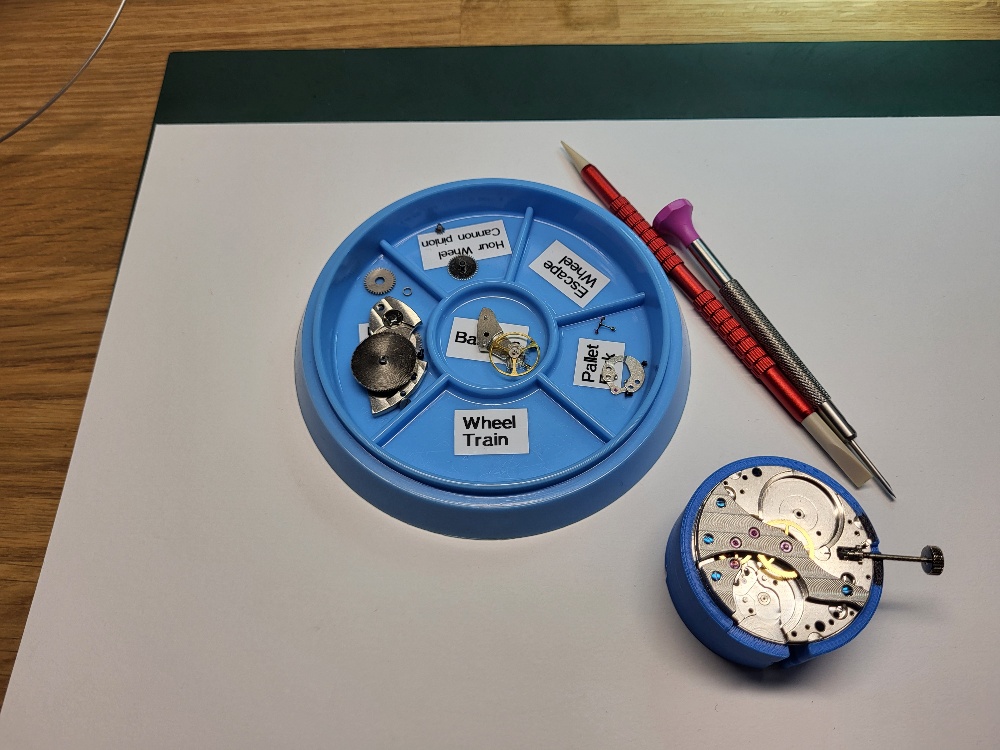
First impressions
One of the things that struck me immediately about the Watchmaking Taster Day was how accessible it felt. Although I had an interest in mechanical watches, no previous watchmaking experience was necessary. The atmosphere was relaxed and welcoming from the outset, and the day was structured in a way that allowed the technical detail to build gradually rather than becoming overwhelming.
Jon’s enthusiasm for watchmaking was a major part of the experience. His passion for mechanical timepieces was obvious. However, he also has the ability to explain quite complicated mechanical principles in straightforward terms. Importantly, the history and technical explanations felt relevant to what we were doing at the bench, rather than simply being theory.
Working at a proper watchmaker’s bench
The quality of the facilities added considerably to the experience. The Battersea classroom features a proper watchmaking environment rather than simply being a space for running occasional workshops. The individual workstations have professional sit-stand benches, good ergonomic seating and appropriate precision lighting. Alongside this was a collection of specialised tools required for working on a mechanical movement.
Particularly useful were the loupes and high-magnification stereo microscopes. Components that appear impossibly small to the naked eye become much more understandable under magnification. Being able to see the teeth of a wheel gives a much greater appreciation of the extraordinarily small tolerances involved in mechanical watchmaking.
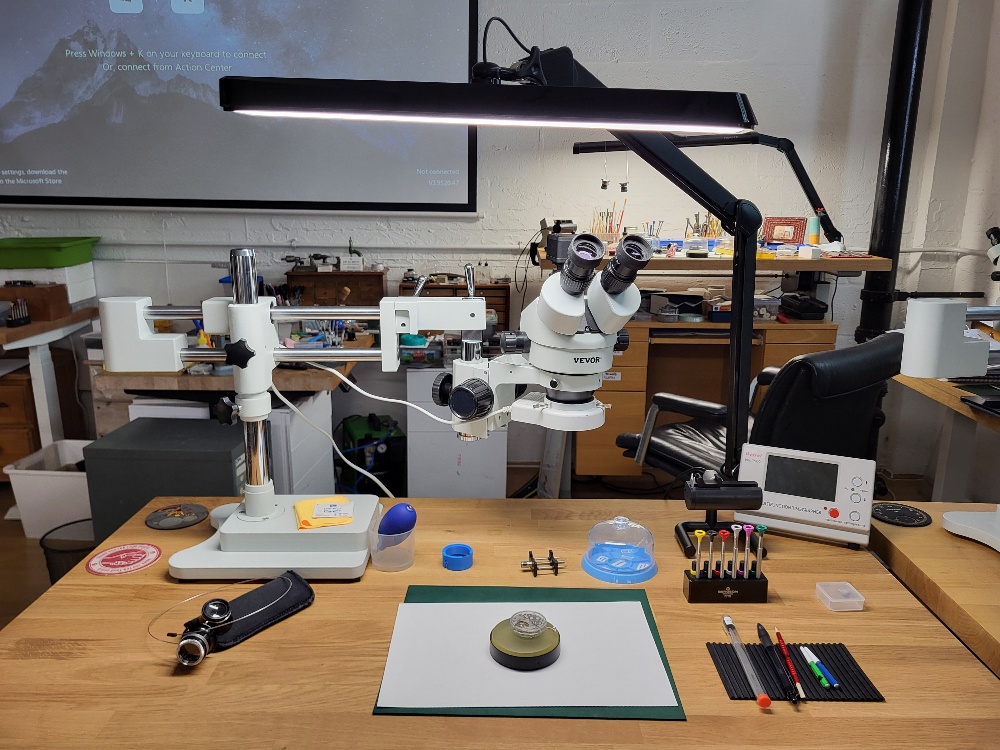
The ergonomic setup proved more important than I might have expected. Spending several hours concentrating on extremely small components requires a comfortable working position, good lighting and the ability to see exactly what is happening. Having professional equipment meant that the challenge came from learning the techniques rather than struggling with inadequate tools or visibility. That said, I must admit at the end of the day I was suffering from eye strain after staring through the loupe for what seemed like hours. I imagine this is probably something you would get used to over time.
Learning from Jon the Watch
Jon was patient, approachable and very hands-on throughout the day. This became increasingly valuable once we began working with the movement itself. There is quite a difference between understanding what a component is supposed to do and successfully persuading a tiny screw, wheel or spring to go exactly where it belongs.
Whenever something became particularly fiddly, help was readily available. Rather than simply taking over, Jon would demonstrate the appropriate technique or help resolve the problem before allowing me to continue. That made it possible to tackle operations that initially seemed rather daunting while still feeling that I was doing the work myself. His teaching style also made the underlying mechanics much easier to understand. As the movement came apart, the relationship between components became increasingly clear. Concepts such as the mainspring, wheel train, escapement, balance and jewels made considerably more sense when I could actually see and handle the components concerned.
The ST36 Movement
The movement at the centre of the day’s practical work was the Sea-Gull ST36. It is a manually wound mechanical movement manufactured by Tianjin Sea-Gull in China and has been produced since around 2005. It’s based on the Swiss ETA 6497, one of the classic large hand-wound movements of the twentieth century.
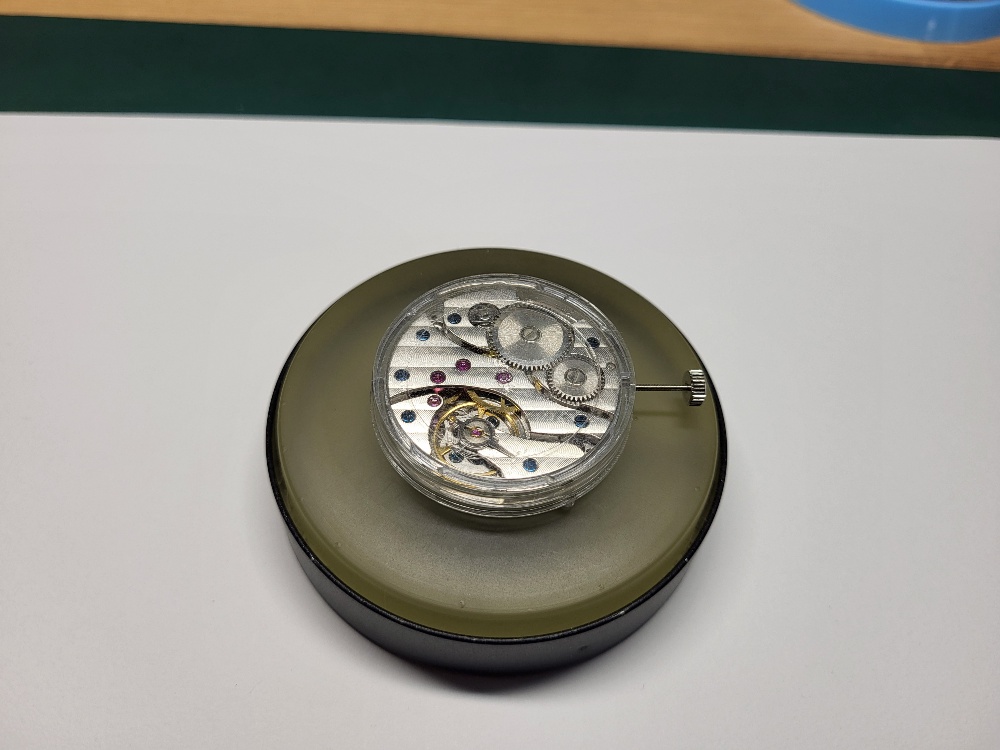
Physically, the ST36 is a large movement, measuring approximately 37.2 mm in diameter (approx. 16.5 Ligne) and 4.5 mm thick. The larger size makes it perfect for this type of watchmaking workshop. The screws, bridges, wheels and balance assembly are still extremely small when encountered for the first time. However, they are sufficiently large to make learning basic handling and assembly techniques realistic for a beginner. The ST36 features 17 jewels, operates at a frequency of 21,600 vph (3 Hz) and has a power reserve of approximately 46 hours. In its standard ST3600 configuration, the hour and minute hands are mounted centrally, with small seconds positioned at nine o’clock.
The Fiddly Bits
There is no escaping the fact that watchmaking can be extremely fiddly. Handling tiny screws, springs, and wheels demands concentration and patience, particularly when trying to position a component without damaging it or disturbing something that has already been assembled. This was also one of the most enjoyable aspects of the day. Tasks that initially appeared almost impossible became achievable with the right technique, magnification and a little persistence. A steady hand certainly helps, but I discovered that technique and patience are at least as important. When a component refused to sit correctly, or threatened to disappear altogether, having Jon nearby to provide individual assistance prevented frustration from taking over.
Working at this scale also gave me a much greater appreciation of the skill involved in professional watchmaking. Something as apparently simple as replacing a bridge requires aligning several holes simultaneously that are barely visible without magnification. Applying lubricant involves depositing an almost microscopic quantity in precisely the correct place. Even tightening a screw requires considerably more finesse than its larger equivalent in everyday mechanical work.
Bringing the movement back to life
The most satisfying moment came towards the end of the day. Having spent the best part of six and a half hours dismantling the ST36 and then rebuilding it, seeing the balance begin oscillating was incredibly rewarding.
There was something particularly satisfying about knowing that the movement running in front of me was the same collection of wheels, screws, and bridges that had been spread across the bench earlier in the day. It transformed the workshop from simply following a set of instructions into something much more tangible.
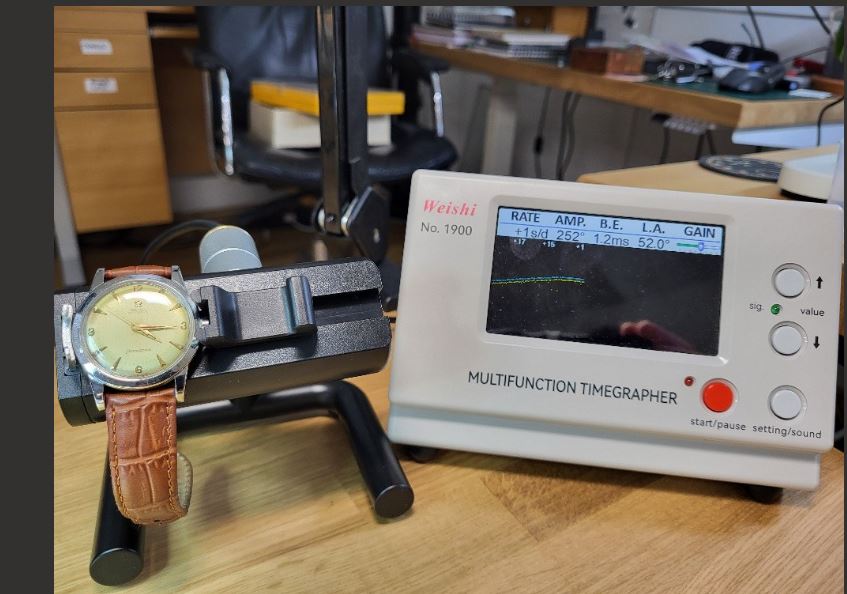
At the end of the day, after regulating the ST36, we were able to check the timekeeping using a Timegrapher. It also gave us an opportunity to test our own watches. I was quite pleased with the timekeeping of both the ST36 and my vintage Omega Seamaster.
Overall Impression
The day managed to strike an excellent balance between being technically interesting and genuinely enjoyable. It was sufficiently detailed to provide a meaningful understanding of mechanical watchmaking, but remained accessible to someone approaching the subject without previous practical experience. What stayed with me most was the combination of Jon’s enthusiasm and patient teaching, the quality of the professional workshop facilities and the satisfaction of doing the work myself. The occasional battle with a microscopic screw was very much part of the experience rather than a downside.
Above all, the day gave me a much stronger appreciation of the craftsmanship behind a mechanical watch. Seeing a movement on a diagram or through a display case is one thing; understanding its history, dismantling it at a watchmaker’s bench, handling its individual components, and eventually watching it burst back into life is quite another.
Leave a Reply