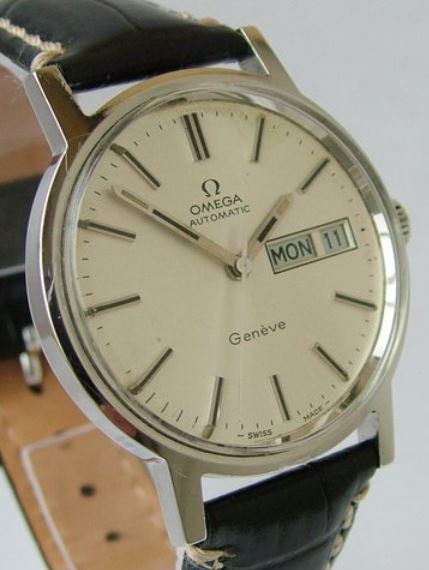
At Set Back in Time, we have a soft spot for the Omega Genève. It was a good-quality watch that always contained high-end Omega calibres. Unfortunately, it just couldn’t find its niche up against the likes of the Constellation, Seamaster and De Ville. Sadly, the range is no longer with us, but there are plenty of vintage Genève’s out there for collectors. Generally, they offer a perfect, reasonably priced starting point for beginners building a vintage Omega watch collection. In this example, we examine an Omega Genève wristwatch dating from 1972 with an automatic movement, stainless steel case and a useful day-date function.
A brief history of the Omega Genève
The Omega Genève range debuted in the early 1950s (widely cited as 1952) on Omega’s dress-watch models. Initially, it paid tribute to the award-winning 30 mm calibres. Positioned just below the top-tier Constellation chronometers, the Genève watches were considered second-tier luxury dress pieces, reflecting Omega’s Geneva heritage and observatory successes.
However, the success of the Omega Professional lines (Seamaster, Speedmaster, and Railmaster) in the late 1950s negatively impacted the Genève line’s marketing and retail position. While still above the entry level. It was viewed as a finely finished, less-expensive alternative to the Seamaster and Constellation. Omega later repositioned the range to a different target market.
By the late 1960s and 1970s, Genève shifted to become Omega’s volume-driven, youth-oriented segment. This covered the mid-market with competitively priced models that still utilised high-quality movements. In 1979, Omega officially discontinued the Genève range (Omega Genève at enigwatch).
Omega calibre 1022 automatic
According to the Ranfft DB, the Omega calibre 1022 was in production between 1972 and 1984 with an estimated run of 78,000 units. The automatic gear is integrated into the movement, instead of attaching it to the manual-wind calibre as usual. Together with indirectly driven minute and second hands, this leaves a space in the centre for a rugged rotor bearing. The calibre 1022 is relatively thin (4.25mm) and has a simple electroplated copper finish and a plain regulator. This is in contrast to the 500 series watches from the previous decade.
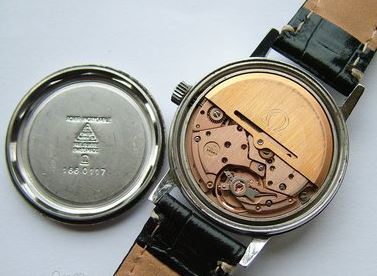
Additionally, it offers a range of functions including sweep second hand, day and date display with quickset capabilities, a hack feature, as well as Incabloc shock protection. The 23 jewel movement has a frequency of 28,800 vph. The movement is signed Omega and it has the Omega logo on the rotor. The Omega serial number dates the watch back to 1972.
Case and dial
The watch measures 34mm in diameter, excluding the Omega-signed winding crown and the lugs. The case is stainless steel and it is in good condition. The inner case back has the Omega triangular logo together with the case reference 166.0117, which is correct for the calibre 1022 movement. Reference 166.0117 is part of the Omega International Collection produced from 1972 to 1979. According to period advertisements, the retail price was CHF 230 in 1972. The lens is in good condition and it has the tiny, clear Omega logo at the centre. This is a nice touch of originality. The crystal is one of the most likely components, along with the crown, to be missing on a vintage watch. The fact that this piece has both original components is a big plus.
The signed dial is in its original finish and, again, in good condition. There is a quick set date function. The date is set by turning the hands backwards. The date is set by pulling the crown out to the first position and turning either way to adjust.
Why isn’t the Genève as collectable as the Constellation or Seamaster?
The Omega Genève models from the 1960s offer excellent timekeeping as they use the same quality movements found in the Seamaster range. In essence, they provided a cheaper route to owning the reliable mechanics of the Seamaster.
However, the difference lies in the external finishing. Models like the Reference 166.041 feature a relatively simple design. The 166.041 has a plain, brushed steel case (identical to most Geneves of the period, excluding the Dynamic) with no decorative facets. The dials and hands also maintain a basic, practical feel. When placed next to a Seamaster or Constellation from the same era, the superior build quality of the higher-tier lines is immediately apparent. Their polished, faceted steel cases, elegant hands and dials, and overall more “designer” appearance easily outclass the more reserved Genève models.
Summary
Despite the comments above, why buy a vintage Omega Genève? Three reasons. You immediately acquire a timepiece from Omega, a globally respected and historically significant Swiss manufacturer. Genève models from the mid-1960s and 1970s often carry the same high-quality movements (like the calibre 1022) found in the more expensive Seamaster range. Genève watches generally trade at a significantly lower price than their Constellation or Seamaster contemporaries. In short, the Omega Genève range allows you to own the quality of a vintage Omega at a price that eases you into collecting.
Related content
Omega history at Omega Chronicle.
Leave a Reply