There are a lot of vintage Nivada watches available in the market. However, the history of the company is really unclear, as there is no definitive source that can pin-point the exact date the company was founded. Wikipedia states, “Nivada is a Swiss watch manufacturing company, founded in the town of Grenchen, Switzerland in 1879 by Jacob Schneider”. There is no source to back up this claim. At the time of writing, the article was flagged as needing additional citations. The article later goes on to state, “In 1926, Nivada was operational in Grenchen as Wüllimann Schneider Nivada S.A.”. This is consistent with many other sources, including the current iteration of the company, Nivada Grenchen and Fratello Watches.
Founders
Apparently at this time the founders were Otto Wüllimann, Hermann Schindler, and Jakob Schneider.Again, there are no citations backing up the date of 1926. Another much referenced data is the apparent 50th anniversary of Nivada said to be in 1976, which neatly aligns with the proposed 1926 date. However, I cannot see any Nivada advertising which references the anniversary.
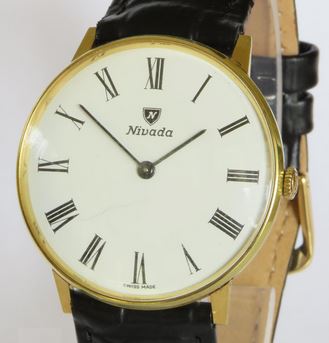
Another reference site which we use regularly at Set Back in Time is Mikrolisk the Horological Trade Mark Index. This site has proven to be the ultimate source for trade mark registration over the years. Mikrolisk, lists Nivada SA / Wüllimann, Schneider & Cie. registering the Nivada trade mark in Switzerland in 1937. Grail Watch Wiki lists the registration of Nivada SA as a “Société Anonyme” on September 20, 1932. Again, not cited.
Unsubstantiated history
Nivada has a murky, unsubstantiated history, which is not that unusual for pre-internet days. The dates aren’t mutually exclusive. A Jacob Schneider could have started a small family watchmaking workshop in Grenchen in 1879. His son or grandson could have linked with Wüllimann and Schindler in 1926, and they may have branded their watches “Nivada”. Trade marks were not always immediately registered, perhaps only being exercised when a brand name had gathered enough market momentum to warrant being protected. Maybe that is why “Nivada” registration didn’t officially occur until 1937? Perhaps someday, an obscure document will appear which confirms this timeline.
Mass production
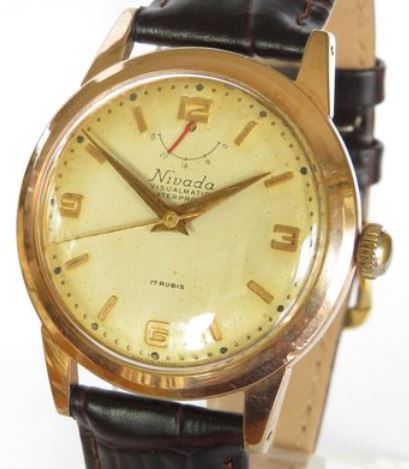
Nivada was not a “watchmaker” producing in-house movements. Instead, it used reliable mechanical movements from makers like Ebauches SA, ETA, Phénix, and A. Schild to deliver reliable, accurate mass-produced watches at a reasonable price. In the 1930s, Nivada largely produced dress watches featuring featured a manually-wound movements. These were available in a range of styles, including round and rectangular, tank style cases.
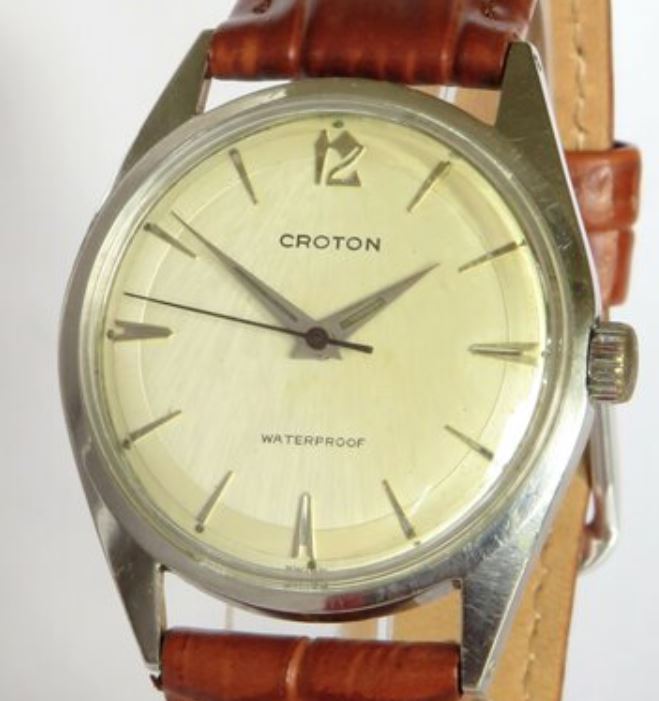
By the late 1930s, Nivada Grenchen had expanded into the United States through a collaboration with the Croton Watch Company, an American watch brand founded in 1878. This partnership enabled the brand to establish a presence in the US market. However, in 1939, Movado, another Swiss watchmaker, challenged the phonetic resemblance of the Nivada name. This forced Nivada to adopt several alternative names, including “Nivada Grenchen”, “Croton Nivada”, “Croton Nivada Grenchen”, and “Croton”.
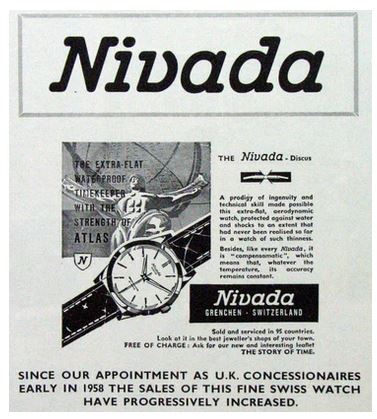
During the 1940s and ’50s, Nivada Grenchen’s popularity continued to grow, particularly after the Second World War. The Buccaneer, produced in several variations, consistently featured manually wound movements with small seconds at the six o’clock position. The Nivada Alert, released in the mid-1950s and powered by the newly developed A. Schild 1475 calibre, introduced a wrist alarm to the brand’s collection. Nivada swiftly adopted new industry standards and, in the 1950s, became one of the first manufacturers to widely promote automatic movements.
Notable Nivada models
The waterproof and automatic Nivada Aquamatic earned a reputation as the company’s most robust watch. Its success propelled Nivada into a new phase of growth. Inspired by scientific expeditions to Earth’s most extreme environments, Nivada developed the Antarctic, using the Aquamatic as its foundation. They were marketed as “waterproof, self-winding, shock resistant, anti-magnetic,” and equipped with an “unbreakable mainspring and balance staff”. Nivada supplied these watches to the US Navy team led by Admiral Robert Byrd for Operation Deep Freeze during their 1955–1956 mission to the South Pole.
Released in 1963, the Chronomaster Aviator Sea Diver served as Nivada’s all-purpose model. It became the brand’s most well-known watch. Designed to perform on land, in the air, and at sea, it offered virtually everything a professional might require. It was powered by a manually wound Valjoux chronograph movement. The dial included a tachymeter for measuring speed, a bi-compax layout with small seconds at nine o’clock, and a chronograph minute totaliser at three. This sub-dial recorded up to 30 minutes of elapsed time. Additionally, with its red accents, it also counted down the final five minutes before an event, such as a regatta.
In 1964, Nivada built on the Chronomaster’s success with the introduction of the Depthomatic. Water-resistant to 200 metres, the Depthomatic was designed specifically for divers. It also became the first watch on the market to incorporate a depth gauge. This function operated through a glass tube surrounding the dial’s perimeter. This filled gradually with red-tinted water as pressure increased during descent. Nivada added the Depthmaster in 1965, offering an impressive water resistance of 1,000 metres. The company marketed it as “probably the world’s most waterproof watch”.
Summary
The Nivada Watch Company produced a very respectable range of watches. Nivada’s most famous models included the trilogy of the Antartic, Chronomaster and Depthomatic. These are readily available online. Although not a watchmaker, Nivada used good quality movements from respected manufacturers such as ETA, Phénix, and A. Schild to deliver reliable mass-produced watches at a reasonable price. However, Nivada suffered during the Quartz Crisis and disappeared into obscurity in the 1980s.
Leave a Reply