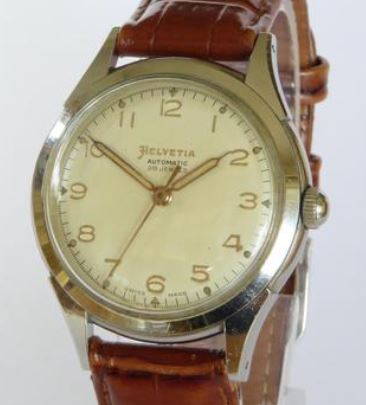
This vintage Helvetia automatic was shared with the Set Back in Time group in one of our normal Friday sessions. It dates from the 1950s and contains a Helvetia 838 automatic movement. The watch is keeping good time, perhaps +1 minute a day fast. However, this is perfectly acceptable for a 70+ year old watch. The Helvetia brand has an interesting history and was for some time closely associated with Omega.
A brief history of the Helvetia brand
In 1892, the Helvetia trademark was registered by Louis Brandt & Frère, the founding family behind Omega. The Brandt family had planned to open a company to manufacture lower-to-mid-range timepieces, so that they could focus on their higher-end brand, Omega. In 1895, the Brandt brothers joined forces with Edouard Boillat of the ébauche firm Ed. Boillat & Cie to establish this company. The company name was “La Générale” in French or “General Watch Company” in English. A factory was established in La Chaux-de-Fonds and the company focused on mid-range watches. The most famous “brand” produced by the General Watch Company was Helvetia. (Helvetia at Chronopedia).
In the following years, the Helvetia and Omega brands were often in production at the same factory. However, the Brandt brothers left the General Watch Company in 1911 to concentrate their attention on their premium line, Omega. In the early 20th century, the General Watch Company expanded into Biel/Bienne and adopted the new wristwatch format. Its reputation grew through the 1920s and 30s as it patented an innovative in-house shock protection system and water-resistant cases. In later years, Helvetia was best known for its 1930s–1940s pilot watches, which often featured striking dials and a distinctive propeller logo. The company continued to be a producer of military, dress, and automatic models, introducing its first automatic movement in 1950.
In 1968, it joined the Société des Garde-Temps group. Despite its long history, the original Helvetia company succumbed to the Quartz Crisis of the 1970s. Vintage Helvetia watches, especially the pilot watches, remain sought-after on the collector’s market today. (Société des Garde-Temps at Grail Watch Wiki).
Helvetia 838 automatic
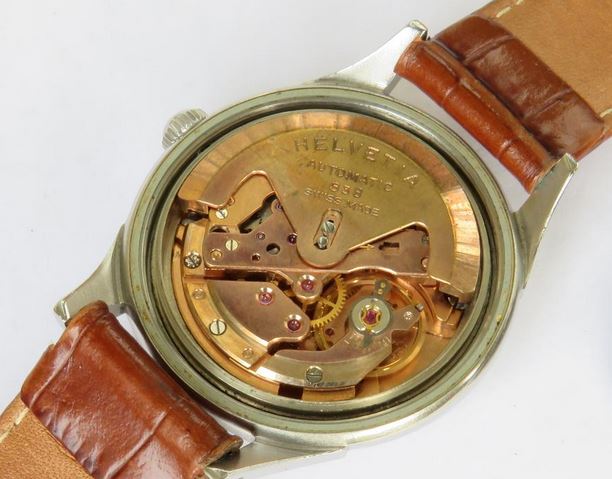
In the early 1950s, Helvetia began to develop a new range of movements to replace the 80 series, which had been in production since the 1920s. The first in the new series was the manual-wind 830. Following the 830, were the 836, 837 and 838 automatic versions. Later on, they added the 844 and 845 (date and non-date automatics). Interestingly, the new range included Incabloc shock protection, which replaced Helvetia’s in-house Shock-Resist system. This particular watch uses the Helvetia 838 calibre. According to the Ranfft database, the 838 calibre has 25 jewels, a power reserve of 43 hours and a frequency of 18,000 vph. Strangely, as with many Helvetia watches, the user turns the crown anti-clockwise to wind the automatic movement.
Case and dial
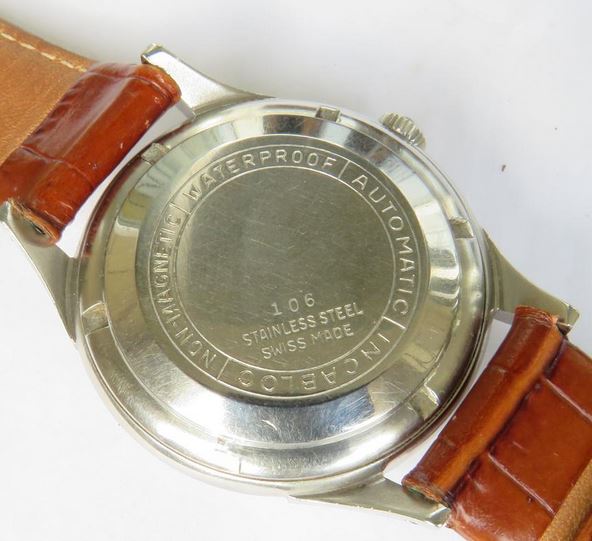
The watch is 34mm in diameter, excluding the winding crown and lugs. Its stainless steel case is in very good condition, and the screw-on case back indicates the watch is “waterproof”. However, as with all vintage timepieces, it is best to keep it away from water and moisture. The acrylic crystal remains in good condition with a few light scratches barely visible to the naked eye. The signed dial is in its original finish with age-related patina. It features its original hands, a centre seconds hand, and an outer minute track. The watch includes a new leather strap which includes quick-release spring bars for easy strap changes.
Summary
This is a classic early 1950s gentleman’s watch, manufactured by Helvetia watch company, with a shock-protected in-house calibre 838 movement. The watch is in good condition, bearing the subtle, age-related patina that collectors admire. Its timekeeping is reasonable and would no doubt improve with a service. Our Set Back in Time member is very happy with the watch as it ticks loudly on his wrist.
Leave a Reply