The Omega Railmaster is a timepiece deeply rooted in the history of both watchmaking and the evolving needs of professionals who require exceptional precision. This story begins with a tragic event in 1891. A train collision in Ohio highlighted the importance of reliable timekeeping for the railroad industry. A train driver relying on a watch that was five minutes fast was responsible for the crash. This led to a major overhaul of timekeeping standards within the railway industry.
In the aftermath, Webster Clay Ball, a watchmaker and jeweller from Cleveland, was appointed as the Chief Time Inspector. His role was to ensure that railway companies were equipped with highly accurate timepieces. This shift in standards led Omega, a company already known for its expertise, to become a trusted supplier to the railway companies at the turn of the century (Webb C. Ball at Wikipedia).
The history of Omega
Louis Brandt established the company in 1848 in La Chaux-de-Fonds, Switzerland. Omega’s history began as a sole proprietorship operating under the Louis Brandt name. Initially, Brandt operated as a comptoir d’établissage, or an assembly workshop. After Louis Brandt’s death in 1879, his sons, Louis-Paul and César, took charge. They relocated the business to Biel/Bienne in 1880. It was there that Omega’s headquarters remain today.
By 1885, Omega had already produced its first mass-produced calibre, the Labrador. They followed this with the first minute-repeater in 1892 and later, in 1894, the creation of the 19-ligne calibre, named “Omega.” The company adopted the name “Omega” in 1903, which became synonymous with precision, innovation, and reliability (Omega at Grail Watch Wiki).
Over the years, Omega’s reputation continued to grow. During both World Wars, Omega supplied military timepieces, including the famous “Dirty Dozen” watches used by the British Ministry of Defence in WWII. Their most iconic models, such as the Seamaster and Speedmaster, have since become legendary. In fact, the Apollo 11 crew wore the Omega Speedmaster when NASA landed the first humans on the Moon in 1969.
The birth of the Railmaster
In 1957, Omega introduced a trio of professional timepieces that would become iconic in their own right. The Seamaster 300, the Speedmaster, and the Railmaster (Omega 1957 Trilogy at Worn & Wound). Specifically, Omega designed the Railmaster (model CK 2914) for engineers, scientists, railway workers, and anyone else working near strong magnetic fields.
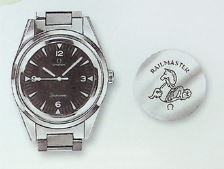
Omega built the Railmaster with protection in mind. It featured a soft iron inner case that acted as a Faraday Cage. This shielded the movement from magnetic fields of up to 1,000 gauss. Omega manufactured the case from Staybrite stainless steel, a material known for its water resistance. The dial was crafted from oxidised soft iron, measuring 1mm thick. This was much thicker than the typical 0.4mm dial found in regular watches. The design was practical, yet durable and aimed to withstand the challenges posed by magnetic fields and tough work conditions.
The design and features
The Omega Railmaster’s design was both functional and visually pleasing. The case was 38mm in diameter, which was considered a modest size by the standards of the time. It also featured a Naiad-type submersible crown and a robust crystal for extra durability. The water resistance rating was 6 ATM, or 60 metres. The watch also included a screw-down case back with an O-ring to further ensure its water-resistant capabilities.
The dial itself was black with a special “Railmaster” inscription, and the hour markers were Arabic numerals. The markers were highlighted with radium, making them visible in low light. The movement of the Railmaster was based on Omega’s renowned Calibre 30 MM, a 17-jewel mechanism known for its reliability and accuracy. This calibre was protected by the “Incabloc” system. This shielded the balance wheel from shock, ensuring the watch remained accurate even in demanding conditions.
Throughout its brief production run, the Railmaster was powered by several different calibres, including Calibre 284 (1955-1959), Calibre 285 (1959-1962), and Calibre 286 (from 1962 onwards) (Omega movements at EmmyWatch). A limited edition of 277 pieces with reference CK 2914, featuring a Seamaster-signed dial and an engraving of “P.A.F.” (for the Pakistan Air Force), was also produced and delivered to the Pakistani Air Force between 1960 and 1961.
The Railmaster’s discontinuation
Despite its groundbreaking design and innovative features, Omega discontinued the Railmaster after just six years of production. While the Seamaster and Speedmaster went on to enjoy long, successful careers, the Railmaster remained a short-lived yet significant model in Omega’s history.
Even today, the Railmaster is a highly respected collector’s piece. Its magnetic resistance, durable design, and historical significance make it a rare find in the world of vintage watches. Though Omega discontinued the Railmaster in 1963, the watch continues to hold a special place in the brand’s legacy.
The watches remained out of circulation until 2003, when Omega reintroduced the Railmaster using its co-axial escapement. The design of this updated version remained largely unchanged, except for the addition of a transparent caseback. However, the watch’s functionality saw a significant update, now incorporating a chronometer. A surprising aspect of this version was the absence of the anti-magnetic casing, making it a distinctive feature in the series. Unfortunately for Omega, this model didn’t gain much traction, leading to another discontinuation in 2012 (Omega Railmaster history at Grail Watch Wiki).
Five years later, the Railmaster made a comeback with the limited-edition 60th Anniversary Trilogy version. Omega only produced 3,557 pieces. While the size and design closely mirrored the 1957 edition, this new version featured the updated Omega Calibre 8806 movement. Material upgrades also enhanced the watch’s resistance to magnetic fields, making it 15 times more resistant than the previous model.
Conclusion
The Omega Railmaster may not have enjoyed the same enduring fame as some of Omega’s other models, but it remains an important part of the brand’s history. It was a watch ahead of its time, designed for those who worked in environments where precision and reliability were essential. The Railmaster’s legacy as a high-performance, anti-magnetic timepiece endures, and collectors continue to seek out this rare model, adding to its value and mystique. Due to the limited production run, vintage Omega Railmasters command a premium, which means for this collector, they are off limits.
Related content
Omega Railmaster at Watch Wiki.
Staybrite steel at Wikipedia.
Leave a Reply