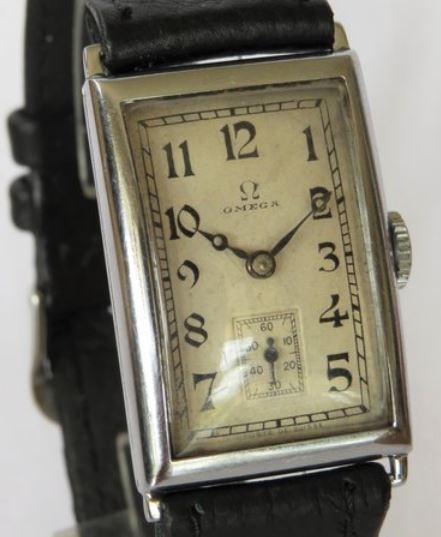
This stylish-looking timepiece from the 1930s is an Omega 20F “tank” gentleman’s wristwatch. The watch features a hand-winding movement, the Omega calibre 20F, which is working well. The movement is signed with the Omega name, and the Omega serial number dates it to the early 1930s. It caught our eye at Set Back in Time. We decided to devote some time to researching the watch and its movement. However, that proved to be frustrating, as there was little online about the calibre 20F. Here is what we uncovered.
A brief history of Omega
In 1848, Louis Brandt laid the foundations of Omega by opening a workshop in La Chaux-de-Fonds, where he painstakingly assembled key-wound pocket watches from locally sourced components. Following the death of Louis in 1879, his sons relocated the company to Biel/Bienne. There, they modernised production by bringing every stage of the manufacturing process under one roof. This transformed the firm into a company that could produce in-house movements.
In 1894, the Brandt brothers unveiled the “Omega” movement. This revolutionary calibre featured interchangeable components and delivered a level of timekeeping accuracy that set a new industry standard. The movement’s success prompted the company to officially adopt “Omega” as its name in 1903, symbolising the “final word” in watchmaking.
Global growth and military service
As the 20th century progressed, Omega’s reputation grew rapidly. In 1932, the brand secured its role as the official Olympic timekeeper, a prestigious partnership that continues today. Throughout this era, Omega engineered highly accurate marine chronometers and pilots’ watches, eventually supplying thousands of robust timepieces to military forces during both World Wars.
Omega calibre 20F
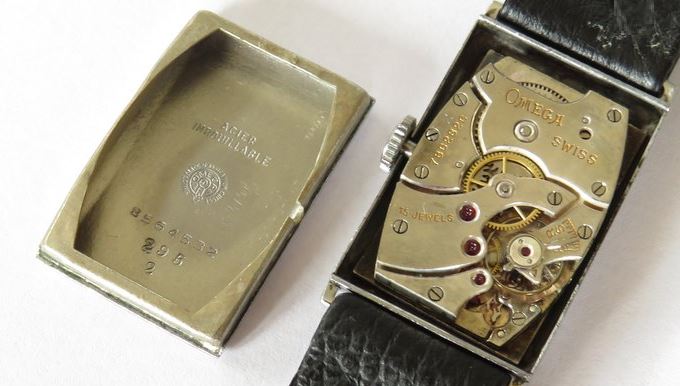
The watch houses one of the early Omega rectangular calibres, the 20F. It is a bar-type calibre with 15 jewels and separate bridges for the winding work and train wheels. Omega developed the calibre 20F manual-wind movement in the late 1920s, and it was in production from 1929 to 1935. The calibre 20F was utilised in many of Omega’s early dress watches and early cushion or rectangular-cased models.
Case and dial
This early Omega timepiece possesses a slender, elegant profile, measuring 22mm in width (excluding the winding crown) and 32mm in height (excluding the lugs). The stainless steel case remains in good condition across the front, while the case back displays some surface scratching consistent with its age. Despite these marks, the watch remains in highly commendable condition for such a significant early piece.
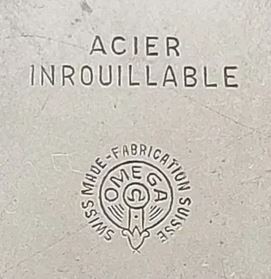
Inside the case back, the early Omega logo is visible alongside the French inscription “Acier Inrouillable”, signifying the pioneer use of “rustproof” or stainless steel. While a later replacement winding crown now winds the movement, the watch largely preserves its historical character. A well-preserved curved lens protects the face, offering an unobstructed view of the dial hands and markers.
The signed dial retains its original finish and an authentic set of hands. The design incorporates a crisp outer minute track and a classic subsidiary seconds dial at the six o’clock position. Beneath the 6 marker are the words, “IMPORTE DE SUISSE”, indicating the Swiss origins. These original elements, combined with the watch’s early steel construction, make it a superb example of Omega’s mid-century design. The watch features a new black leather strap.
Summary
The Omega calibre 20F was challenging to research as none of the usual sources contained anything of substance. The little information we have written above was sourced through casual observations and cross-referenced comments in various online forums. We weren’t able to provide a source from a recognised authority. All we can say is we did our best. However, the watch in question is very stylish and would enhance any watch enthusiast’s collection.
Leave a Reply