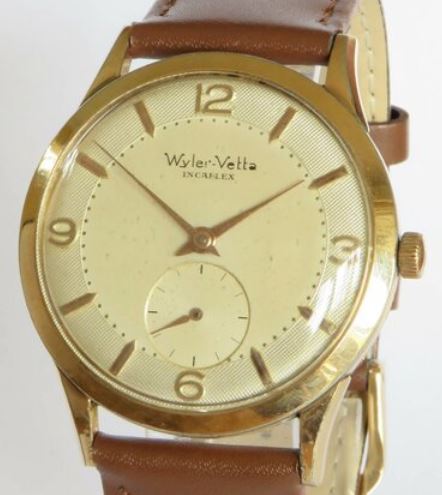
The Wyler Watch Company is an obscure brand that we uncovered when researching shock protection systems. Wyler is perhaps best known for their in-house shock protection system called Incaflex. They advertised this system by dropping two Wyler watches from the top of the Eiffel Tower. Both watches were damaged in the fall, but were confirmed to be running afterwards. This Wyler Vetta wristwatch dating from the 1950s is the product of the Italian branch of the Wyler company.
A brief history of Wyler Vetta
Wyler Vetta has its origins in the Wyler Watch Company, established in Basel, Switzerland, in 1924 by two brothers, Paul and Alfred Wyler. In 1933, the Wyler brothers joined forces with the Italian entrepreneur Innocente Binda to officially register the Wyler Vetta name. This partnership merged Swiss technical precision with Binda’s sharp commercial intuition. This created a brand that could navigate the complex European market of the interwar period (Wyler at Chronopedia).
They chose the “Vetta” name, meaning “summit” in Italian, to ensure the brand resonated with consumers in Binda’s home country. This strategic move also addressed the era’s sensitive political climate. The Italian government was becoming increasingly nationalistic in the years before WWII. An Italian-sounding name was almost a prerequisite for doing business in the country. By softening the foreign sound of the “Wyler” name, the partners avoided potential negative connotations. This protected the brand’s reputation during a time of rising nationalism.
In 1934, Innocente Binda revolutionised watch marketing when he proposed that the Italian national football team wear Wyler Vetta timepieces. At a time when such collaborations were unheard of, his decision to link a watchmaking house with international sport broke entirely new ground. This visionary move proved to be a stroke of absolute genius. Italy fought their way to victory and secured their first-ever World Cup title that same year.
Post WWII
After WWII, Wyler Vetta’s choice of ambassadors began to change. As Italy entered a period of post-war reconstruction and economic growth, leading figures from cinema and entertainment joined successful sportsmen in wearing the brand’s watches. One notable example was Vittorio De Sica, whose film “Bicycle Thieves” appeared in 1948. When the film received the Academy Award for Best Foreign Language Film in 1950, De Sica wore a Wyler Vetta on his wrist.
The company continued to develop new watches during the 1950s. It introduced the Dynawind automatic model in 1951, followed by the Stratowind world-time watch in 1954. The Binda Group also embraced new forms of advertising and, in 1953, became the first company to promote a watch on Italian commercial television. Wyler Vetta continued to use dramatic publicity stunts to demonstrate the durability of its watches. In 1956, two watches equipped with the Incaflex shock-protection system were dropped 300 metres from the Eiffel Tower. Both watches were damaged in the fall, but were both working afterwards.
The Quartz Crisis brought serious challenges during the 1970s. Wyler joined several other Swiss manufacturers in an attempt to develop a quartz watch with a digital liquid-crystal display. The proposed model, named the Ditronic, never reached production, and Wyler Vetta struggled to compete as quartz watches transformed the industry. In 1993, the Binda family permanently acquired the Wyler brand. The company still exists today.
Wyler ETA 1132 movement
Manufactured around 1950, the Wyler ETA 1132 is a hand-wound movement featuring specific modifications by Wyler. Central to its design is the signature Wyler Incaflex shock protection system. This ingenious setup utilises elastic spiral balance spokes to safeguard the movement’s most delicate components. According to the Ranfft DB, the Wyler ETA 1132 features 17 jewels, a 43-hour power reserve and a frequency of 18,000 vph.
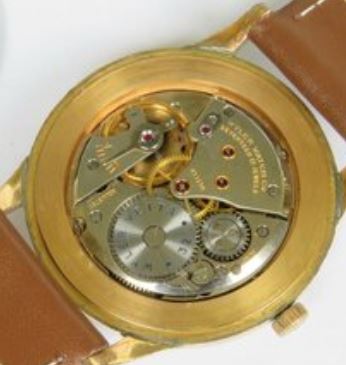
Wyler’s engineers further enhanced the calibre by introducing a disc-shaped lever bridge and a specialised nose at the train bridge to limit the spring travel of the balance precisely. They also refined the architecture of the crown wheel bearing, securing it with three screws rather than the conventional single centre screw to provide superior stability.
Case and dial
The watch measures 37mm in diameter excluding the winding crown and the lugs. This is a size that feels remarkably modern for a mid-century piece. The main case is gold-plated while the case back is stainless steel. The gold-plating shows some wear commensurate with age. This is nothing more than a few light scratches from normal daily use. Overall, the case condition is very good.
The dial itself retains its original finish and features its authentic hands, a subsidiary seconds dial, and precise minute markers. There is some age-related flecking on the dial. However, this simply adds character and doesn’t detract from the appearance of the watch. Both the dial and the interior of the case back include the Wyler Vetta signature. This model is also branded “Incaflex” on the dial, highlighting Wyler’s innovative, in-house shock protection system. This clever piece of engineering consists of two curved and flexible arms which sit on the sides of the balance wheel. Together, these arms act as shock absorbers, shielding the fragile balance from the rigours of everyday life.
Summary
A nice-looking watch from an obscure brand. We liked the patina on the dial and the reliable ETA based movement. However, this watch was more of a curiosity for us. It certainly wouldn’t be considered an investment piece. That said, someone else thought better of it because the watch was sold soon after we wrote this post.
Related content
The Wyler Vetta website.
Leave a Reply