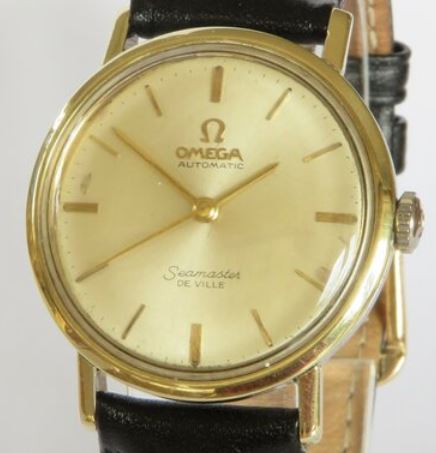
This particular example of an Omega Seamaster De Ville wristwatch was brought to the attention of the Set Back in Time group in the lead-up to Christmas. It was high on the wishlist of one of our regulars, who wanted a second opinion before they made a purchase. Compared to more famous Omega lines like the Speedmaster or Constellation models, vintage De Villes are often more affordable.
Omega De Ville, a brief history
The Omega De Ville collection emerged in 1960 as a refined series under the highly successful Seamaster range. Conceived as Omega’s dress watch line, the early De Ville models successfully merged durability with elegance. They utilised the sturdy, water-resistant monocoque (single-piece) case structure inherited from the Seamaster. The monocoque design didn’t come with a classic case-back, but the movements were front-loaded into the case and sealed with the dial, crystal and bezel. This improved water resistance. However, they still maintained a distinctly slim, elegant profile suitable for formal wear. These watches featured clean, minimalist dials and cases in stainless steel or gold-plated finishes. Furthermore, the De Ville was built upon Omega’s history of smaller, sophisticated movements, including the legacy of the Ladymatic (1955), one of the world’s first automatic wristwatches designed for women (Omega De Ville at Watch Wiki).
Independence
In 1967, Omega separated the De Ville from the Seamaster line, establishing it as an independent collection. The Seamaster name was removed from the dials, a change that focused the De Ville on urban sophistication. Throughout the 1970s, the line became known for its design versatility. It featured a broad range of case shapes, from traditional round models to rectangular designs, powered by both manual and automatic movements. In a nod to the era’s technological shift, Omega also integrated highly precise quartz calibres into certain De Ville models in the late 1970s. This combination of refinement, reliability, and innovation earned the De Ville several significant international design awards. This included international recognition for its design at the Grand Prix Triomphe de l’Excellence Européenne and Baden-Baden Design Awards in the 1970s. The Deville range has included tourbillon (1994), Co-Axial (1999) and chronograph (2002) variants (The De Ville is born at Omega).
Omega 671 calibre
The Omega 671 watch movement was in production from 1961 to 1971. It shares numerous components with the manual-wind Omega calibre 620 family. At 18 mm in diameter, the calibre 671 is a relatively small size for the era, perfect for dress watches such as the Omega Seamaster and De Ville models. The 672 variant of this movement was certified as a chronometer. The 671 features several functions, including an automatic winding mechanism, sweep seconds hand and Incabloc shock protection. The movement is fully signed and has an Omega serial number dating it to 1965.
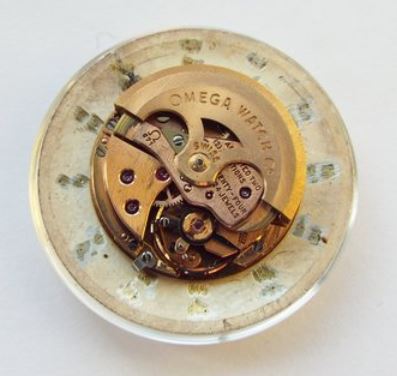
According to the Ranfft DB, the calibre 671 has 24 jewels, a frequency of 19,800 vph, with a power reserve of 40 hours. The calibre 671 has a reputation for being a solid “workhorse” movement, known for accurate timekeeping and durability.
Case and dial
The watch measures 34mm in diameter, excluding the winding crown and the lugs. The case is stainless steel and is in very good condition. The case back has the raised Seamaster logo to the outside and the Omega logo on the inside, together with the case reference 165.004, which is correct for the 671 movement. Overall, the case back is in good condition with just light surface marks. Collectors would consider this patina, rather than damage.
The plain winding crown is a later replacement. It is not unusual for the crown to be replaced, although it is more common on hand-wound movements. The crystal is in lovely condition, and as a touch of originality, it has the tiny clear Omega logo in the centre. The signed dial has black and gold number markers, original black hour and minute hands, and a gold seconds sweep. The dial is in its original finish and is in very good condition, with only a couple of age-related flecks. The watch features a new black leather strap with a plain buckle.
Summary
It’s a nice-looking dress watch, which is running well and keeping good time. It is largely authentic, with only the replacement crown that detracts from its overall originality. The 1960s De Ville range is noted for its clean dials, slim profiles, and understated cases. They are suitable for both formal and daily wear and are a perfect example of the mid-century era of watchmaking. However, as nice as this watch was, it wasn’t purchased as the missing crown detracted from its overall originality. Not that we know anything, some other collector purchased the De Ville before this post was live. What do we know?
Related content
History of Omega De Ville at SwissWatchExpo.
Leave a Reply